

When a ransomware attack, hardware failure, or natural disruption hits a Burbank business, two numbers decide how much data you lose and how long you stay down: your Recovery Point Objective and your Recovery Time Objective. These metrics shape every backup schedule, replication strategy, and disaster recovery playbook your IT team maintains.
This guide explains what RPO and RTO mean in practical terms, how Burbank businesses in media, manufacturing, and professional services set them, and what steps close the gap between ambition and reality.
Key takeaways from this article:
- RPO measures the maximum data loss you can tolerate, expressed in time: a one-hour RPO means you never lose more than one hour of work.
- RTO measures the maximum downtime you can tolerate before business impact becomes unacceptable.
- Tighter RPO and RTO targets demand more frequent backups, faster storage, and often cloud-based replication with automated failover.
- A written disaster recovery plan with tested RPO and RTO targets reduces average recovery costs and shortens decision-making during an actual incident.
What RPO means for data protection
Recovery Point Objective, or RPO, defines the maximum age of files that must be recovered from backup to resume normal operations after an interruption. If your organization sets a four-hour RPO, your backup strategy must capture data at least every four hours, so a midday failure never forces you to re-create more than four hours of transactions, creative work, or customer records.
RPO is not a technical default. It is a business decision that starts with asking how much recreated work costs in labor, missed deadlines, and customer trust.
A post-production house in Burbank with active client deliverables may need a 15-minute RPO, while a small professional services firm with lower transaction volume might accept four hours.
Burbank Business Backup and Recovery Planning Checklist
- ✓Identify all critical business systems and rank by revenue impact: Complete
- ✓Assign RPO target to each system based on cost of data recreation: Complete
- ✓Assign RTO target to each system based on cost of downtime: Complete
- ✓Document current backup frequency and compare to RPO target: In progress
- ✓Map replication topology and verify failover paths exist: Pending
- ✓Test recovery of Tier 1 systems quarterly, document actual RTO achieved: Pending
- ✓Maintain offline runbooks with vendor contacts and license keys: Pending
- ✓Review and update plan after any infrastructure or organizational change: Annual task
Use this checklist during annual business continuity planning reviews and after any major system change.
What RTO means for business continuity
Recovery Time Objective, or RTO, sets the maximum acceptable duration between the start of an outage and the restoration of critical business functions. A four-hour RTO means your disaster recovery process must bring email, order entry, production systems, or client-facing services back online within four hours, or the business suffers unacceptable damage.
RTO drives infrastructure decisions more directly than almost any other metric. A one-hour RTO for a core application typically requires warm standby servers, automated failover, or cloud-based disaster recovery services.
A 24-hour RTO may allow for manual intervention, off-site tape retrieval, and rebuild-from-scratch procedures.
How RPO and RTO work together in disaster recovery planning
RPO and RTO are independent variables that must be balanced against cost and complexity. A business can tolerate very little data loss but accept longer downtime, or demand rapid recovery while accepting more data loss, though most organizations want both numbers as low as feasible.
The combination defines your disaster recovery tier for each system. A Tier 1 system with a one-hour RPO and a two-hour RTO demands continuous replication and hot standby infrastructure.
A Tier 3 system with a 24-hour RPO and a 72-hour RTO might rely on daily backups and next-business-day hardware replacement.

Setting realistic targets for Burbank business environments
Burbank’s business mix includes entertainment and media production, aerospace and advanced manufacturing, retail, and professional services. Each sector faces different regulatory pressures, client expectations, and revenue models that shape what RPO and RTO values are realistic and necessary.
Media production companies often work with large unstructured files that change continuously. A 15-minute RPO for active project storage may require storage-level replication rather than traditional backup agents, which struggle with multi-terabyte file sets.
Building a checklist to close the gap between targets and capabilities
Closing the RPO-RTO gap starts with honest assessment of current backup and recovery performance, followed by prioritized investment in the biggest mismatches. A checklist approach keeps the evaluation systematic and produces documentation that satisfies auditors, insurers, and leadership.
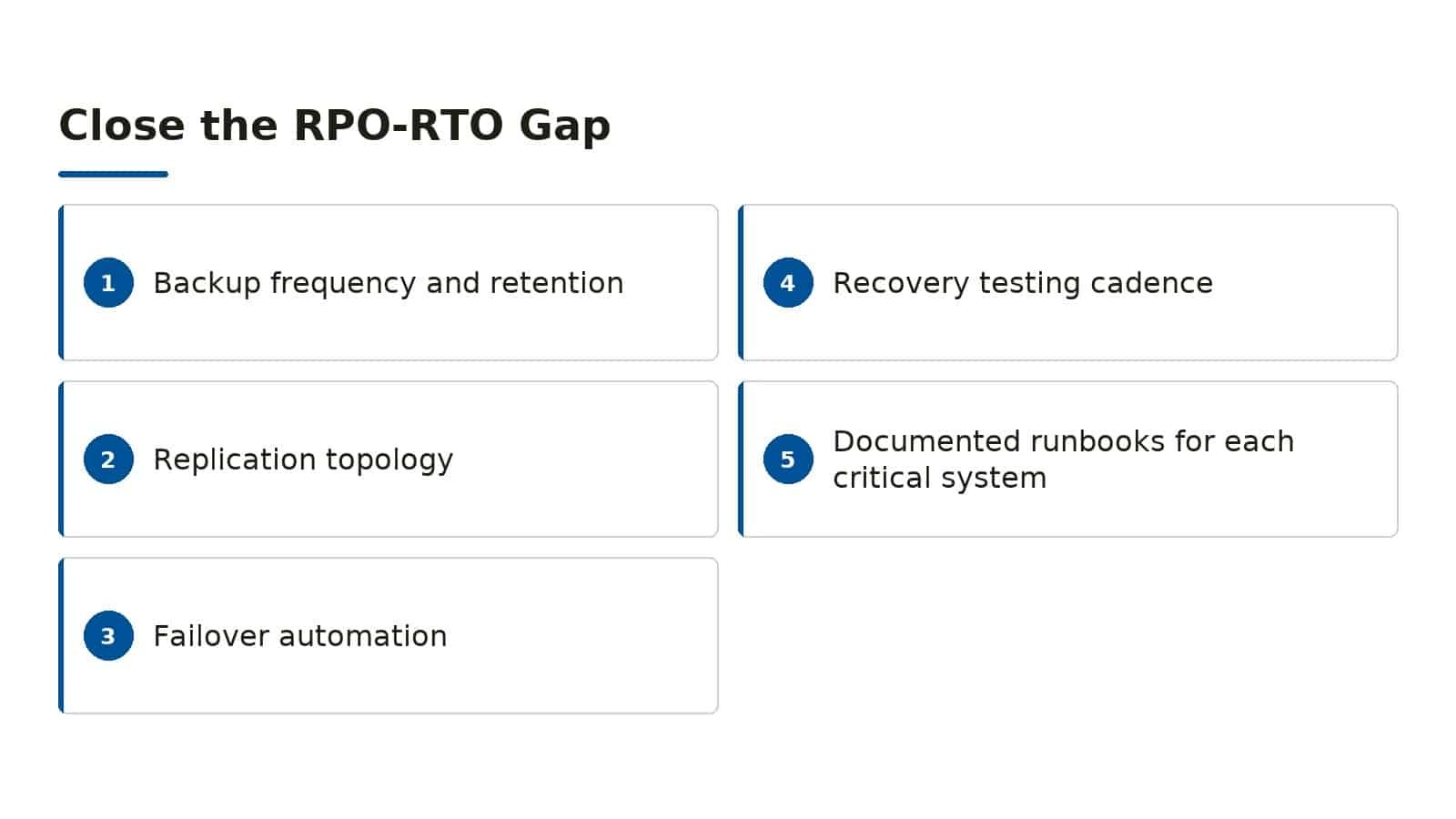
The checklist should cover backup frequency and retention, replication topology, failover automation, recovery testing cadence, and documented runbooks for each critical system. Each item gets a current-state rating and a target-state rating, with the gap defining the project backlog.
How TVG Consulting supports Burbank businesses with backup and recovery planning
TVG Consulting has spent more than 20 years designing and managing IT infrastructure for businesses in the Greater Los Angeles area and Middle Tennessee. The company holds FBI InfraGard membership and has been recognized as a Top 250 MSP Nationwide, with over 90 five-star reviews from clients who have tested its response under pressure.
For Burbank businesses, TVG Consulting provides business continuity consulting that maps critical systems to realistic RPO and RTO targets, then builds the backup, replication, and failover infrastructure to meet them. The team also delivers incident response services for ransomware attacks, email fraud, and insider threats, with procedures that preserve evidence and restore from clean backups without paying ransom.
How Burbank’s unique risk profile shapes RPO and RTO priorities
Burbank sits at the intersection of seismic activity, wildfire exposure, and dense digital infrastructure. These layered risks mean local businesses cannot copy-paste disaster recovery plans from other regions.
Earthquake damage can sever fiber connections and disable on-premises systems without warning. A Burbank media production company might need an RTO measured in minutes, not hours, to prevent missed broadcast deadlines.
Wildfire season brings preemptive power shutoffs that strike with little notice. These events test whether your backup power and data replication can sustain operations while employees work remotely.
The city’s concentration of entertainment and aerospace firms creates high-value intellectual property that demands aggressive RPO windows. Losing even one hour of raw footage or engineering simulations carries steep financial consequences.
Local businesses also face ordinary threats: water main breaks, construction accidents, and traffic incidents that block access to facilities. Each scenario requires its own RTO consideration beyond the dramatic disaster narrative.
Understanding this risk mosaic helps Burbank leaders avoid over-investing in one threat while neglecting another. Balanced planning accounts for both catastrophic and commonplace disruptions.
TVG Consulting evaluates each client’s geographic and operational context before recommending RPO and RTO targets. Generic benchmarks rarely survive contact with Burbank’s specific challenges.

The hidden costs of misaligned RPO and RTO commitments
Setting recovery targets without matching infrastructure investment creates dangerous gaps. These gaps manifest as hidden costs that accumulate long before any disaster occurs.
An overly aggressive RTO with insufficient replication infrastructure forces expensive emergency responses. Staff burn out maintaining systems that cannot realistically meet promised recovery speeds.
Conversely, a relaxed RPO paired with frequent manual backups wastes productive hours. Employees spend time on repetitive data protection tasks that automation could handle more reliably.
Customer trust erodes when actual recovery performance diverges from contractual or marketing claims. Burbank businesses serving national clients may face penalties or lost renewals after missed recovery commitments.
Insurance premiums and coverage terms increasingly reflect verified disaster readiness. Misaligned targets can raise rates or leave critical exposures uncovered after an incident.
Internal decision-making suffers when leadership believes protection levels are higher than reality. Departments make risky choices based on false confidence in data survivability.
Regular alignment reviews between technical teams and business stakeholders prevent these drifts. TVG Consulting facilitates these conversations to keep targets, capabilities, and costs in honest balance.
Emerging technologies reshaping RPO and RTO possibilities for Burbank firms
Continuous data protection now allows RPOs approaching zero for critical workloads. Rather than scheduled snapshots, every write operation streams to protected storage in near-real time.
Immutable backups stored on write-once media protect against ransomware that seeks to encrypt or delete recovery points. This technology directly supports tighter RPOs by preserving more granular recovery options.
Orchestrated failover automation compresses RTOs by eliminating manual decision points during declared disasters. Pre-staged cloud environments spin up with validated configurations rather than requiring improvised rebuilds.
Edge computing deployments in Burbank and surrounding areas reduce latency for distributed backup operations. Local processing maintains protection even when core network paths experience degradation.
Artificial intelligence assists in predicting failure patterns and pre-positioning recovery resources. These capabilities do not replace human judgment but accelerate the earliest phases of incident response.
Containerized application architectures enable faster recovery by packaging dependencies with workloads. What once required hours of server configuration now launches in standardized units measured in minutes.
TVG Consulting tracks these developments to advise Burbank clients on practical adoption timelines. Not every emerging technology suits every environment, but understanding the landscape prevents premature obsolescence in recovery planning.

Frequently Asked Questions
What is the difference between RPO and RTO in simple terms?
RPO measures how much data you can afford to lose, expressed as a time window. RTO measures how long you can afford to be down before business damage becomes unacceptable.
A one-hour RPO means you never lose more than one hour of work. A four-hour RTO means you must be back online within four hours of failure.
How do I determine the right RPO and RTO for my Burbank business?
Start by calculating the cost of data loss and downtime for each critical system. Interview department heads about peak periods, regulatory deadlines, and client commitments.
Map systems to tiers based on business impact, then assign RPO and RTO values that match the cost of protection to the cost of failure.
Can cloud backup solutions improve both RPO and RTO?
Cloud-based replication and snapshot services can compress RPO to minutes and RTO to under an hour for critical systems. Continuous data protection streams changes to cloud storage as they occur, eliminating the backup window entirely.
Failover to cloud instances replaces hardware rebuild time with a simple DNS or routing change.
How often should we test our disaster recovery plan?
Test at least annually for every critical system, and quarterly for Tier 1 systems with the tightest RPO and RTO targets. Testing frequency should increase after any infrastructure change, vendor migration, or organizational restructuring that affects system dependencies.
What role does documentation play in meeting RTO targets?
Documentation is often the bottleneck that turns a technically achievable RTO into a failed recovery. Runbooks must be current, accessible offline, and written for execution under stress, not for reading during calm planning sessions.
What happens if our actual recovery speed falls short of our RTO during a real disaster?
Falling short of your RTO typically triggers cascading consequences: revenue loss from extended downtime, contractual penalties with clients, regulatory scrutiny if data protection mandates were missed, and reputational damage that outlasts the technical recovery. The gap between target and actual performance also exposes planning flaws that should have surfaced during testing.
TVG Consulting recommends conducting honest post-incident reviews that distinguish between unrealistic targets, underinvested infrastructure, and execution failures. Each root cause demands different corrective action.
Building buffer into your stated RTO, rather than promising the theoretical best case, creates more sustainable expectations and reduces the frequency of painful misses.

About the author
Garett Chipman - CEO, TVG Consulting
Garett Chipman is an IT executive and entrepreneur with more than 20 years of experience designing business technology solutions. He founded TVG Consulting in 2005 after holding CTO and management roles at companies including GRB Entertainment and AMG, and as CEO he oversees overall client operations, strategic technology decisions, and custom AI and automation design.