
Cybersecurity pricing is one of the most confusing line items in any Burbank business budget, because the cost varies dramatically based on company size, industry, compliance requirements, and the specific services you buy. This guide breaks down real 2026 price points for every major security layer, from endpoint protection and email security to SIEM monitoring and annual penetration testing, so you can build a budget that actually reflects your risk.
TVG Consulting has worked with Burbank businesses across entertainment, healthcare, professional services, and technology for years, and the pricing questions we hear most often come down to the same core concern: am I spending enough to avoid a breach, and am I spending it on the right things? The answer starts with understanding what each layer costs and what each layer actually protects.
Key takeaways from this article:
- Small Burbank businesses typically spend $5,000 to $25,000 per year on cybersecurity, while mid-size firms commonly budget $25,000 to $150,000 depending on headcount, compliance needs, and monitoring depth.
- The average US data breach costs $10.22 million according to IBM’s 2025 report, making even a $25,000 annual security budget a fraction of the exposure a single incident can create.
- Managed Security Services Providers (MSSPs) cost $50 to $350 per user per month and typically deliver more coverage per dollar than a single in-house security hire for businesses under 200 employees.
- Email security and security awareness training are the highest-return investments for most Burbank businesses because phishing and credential theft are the entry points for the majority of breaches.
Why Cybersecurity Spending Is Non-Negotiable for Burbank Businesses
Burbank sits inside one of the most target-rich business corridors in California, with entertainment studios, post-production houses, healthcare clinics, and professional services firms all concentrated in a compact geography. Each of these businesses handles the kind of data attackers prize most: intellectual property, patient records, financial data, and client personally identifiable information.
The FBI’s 2024 Internet Crime Complaint Center report recorded $16.6 billion in US cybercrime losses, and IBM’s 2025 Cost of a Data Breach Report found the average US breach now costs $10.22 million, an all-time high for any country in the stud y. For a Burbank business, that is not an abstract global figure; it is the benchmark for what a single incident can cost before cleanup, legal fees, and lost client revenue are factored i
n.
A ransomware hit on a Burbank media production company does not just mean encrypted files. Stolen pre-release footage, halted post-production timelines, and compromised vendor contracts each carry their own financial and reputational consequences that a recovery vendor cannot fully reverse.
The practical takeaway is that proactive cybersecurity spending is always cheaper than reactive breach response. The question for most Burbank owners is not whether to budget for security, but how to size that budget correctly for their headcount, their data risk, and their compliance obligations.
Before committing to a full security stack, many Burbank and nearby businesses start with a Free It Risk Assessment Hollywood to identify their most critical vulnerabilities and prioritize spending.
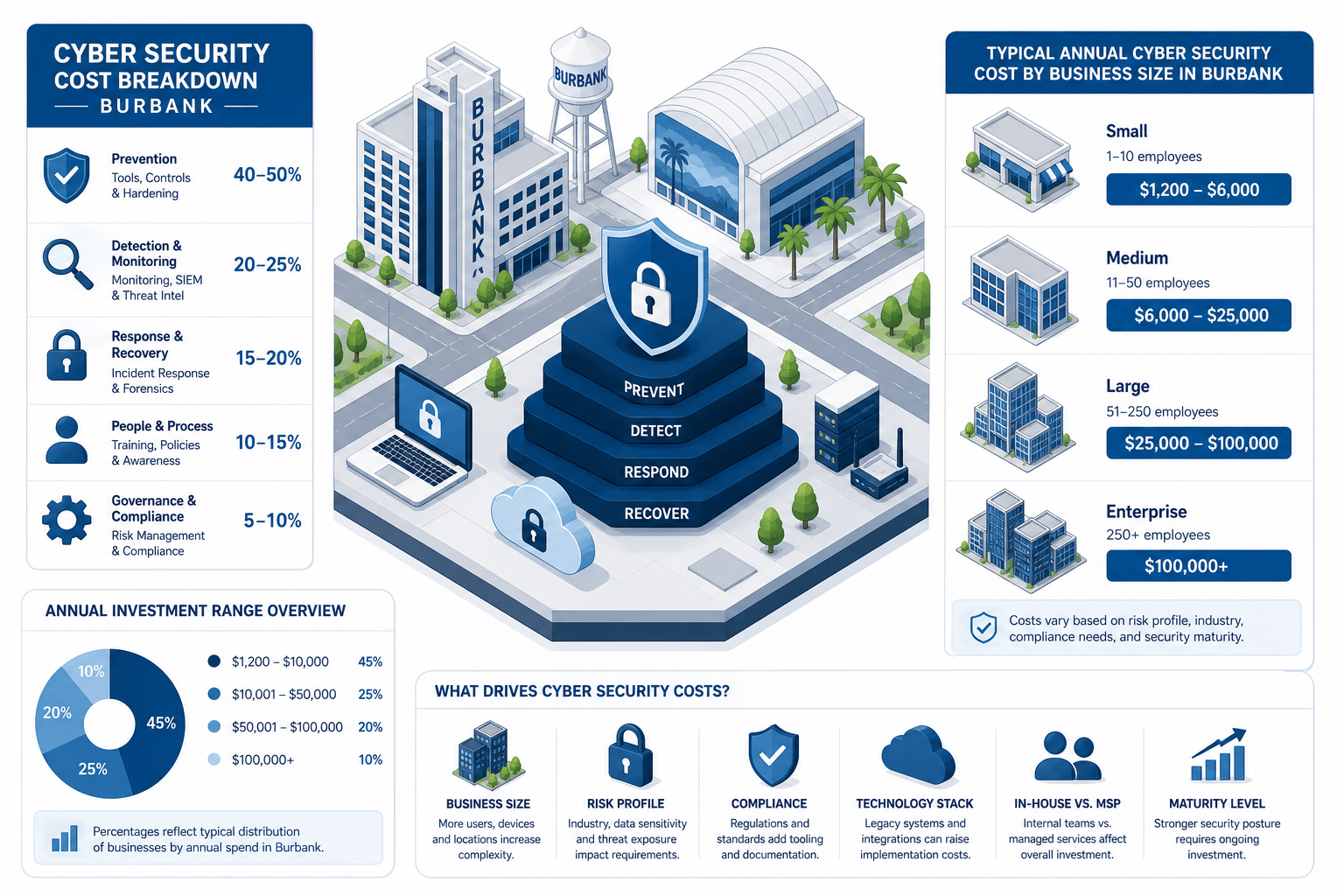
2026 Cybersecurity Cost Reference: Service-by-Service Pricing for Burbank Businesses
Pricing based on 2026 industry benchmarks and IBM Cost of a Data Breach Report 2025. Individual costs vary by vendor, scope, headcount, and compliance requirements.
Cybersecurity Cost Tiers: From Small Office to Mid-Size Firm
Small Burbank businesses with 10 to 50 employees typically budget $5,000 to $25,000 per year for core cybersecurity protections covering endpoint detection, a managed firewall, email security, and basic staff training. The low end fits a lean 10-person office, while the high end adds richer endpoint coverage for 25 or more devices, a more capable firewall, and quarterly vulnerability scanning.
Businesses Small business owners in the broader Los Angeles area can compare these Burbank figures against regional averages to see how their own cybersecurity budgets stack up.
Mid-size firms with 50 to 250 employees face a steeper cost curve driven by the need for dedicated security monitoring, vulnerability management, and incident response planning. Compliance costs for frameworks like HIPAA, CMMC, or SOC 2 layer on top of the baseline, pushing annual spending to $25,000 to $150,000 at this scale.
A concrete Burbank example: an 80-person accounting firm serving entertainment clients would likely spend $40,000 to $75,000 per year once SIEM-based log monitoring, endpoint coverage for 80 devices, and a compliance-aligned email security gateway are all in place. That same firm without heavy compliance obligations might land closer to $30,000, but one audit finding or ransomware incident reshapes the math quickly.
Enterprise-level organizations with 250 or more employees typically exceed $150,000 annually and often retain a full-service MSSP or hire dedicated security staff. At this tier, compliance management, vendor risk programs, and threat intelligence feeds each become budget line items in their own right.
Per-Service Cost Breakdown: What Each Security Layer Actually Costs
Budgets are built line by line, and knowing the 2026 market rate for each security layer lets you evaluate vendor proposals and spot pricing that is out of range. The core services below cover the protection stack most Burbank businesses need.
Endpoint Detection and Response (EDR) runs $3 to $10 per endpoint per month for a software-only deployment that guards laptops, desktops, and servers against ransomware, malware, and zero-day threats. Adding 24/7 SOC monitoring raises the per-device cost to $15 to $25 per month, depending on the provider and the depth of analyst coverage.
Email security gateways start at $2 to $5 per mailbox per month for basic filtering and run $8 to $15 per mailbox per month for advanced protection on Microsoft 365 or Google Workspace. For Burbank media and professional services firms whose teams live in email all day, this layer is the single highest-return investment against phishing attacks.
SIEM or security monitoring platforms carry a recurring monthly cost of $500 to $5,000, scaling with log volume and the number of data sources being correlated. Smaller deployments on cloud-hosted SIEM platforms sit near the low end, while full deployments with custom alerting and round-the-clock analyst review push toward $5,000 per month.
Security awareness training is the most cost-effective line item on any security budget, running $15 to $50 per user per year for a program that includes ongoing phishing simulations and compliance-aligned modules. Human error is a factor in more than a quarter of all data breaches, and a training program that measurably cuts phishing click rates delivers an outsized return relative to its cost.
Annual penetration tests range from $5,000 to $50,000 per engagement, with scope and the number of systems tested driving the spread. Most small and mid-size Burbank businesses can get a thorough external and internal pen test for $8,000 to $20,000, and many compliance frameworks require one at minimum annually.
Managed Security vs. In-House: Which Model Fits Your Burbank Business
Two delivery models dominate the SMB security market: outsourcing to a Managed Security Services Provider (MSSP), or building internal security capacity by hiring staff. For most Burbank businesses under 200 employees, the MSSP model delivers broader coverage at lower total cost.
An MSSP typically costs $50 to $350 per user per month, translating to roughly $30,000 to $100,000 per year for a firm with 50 to 75 users. That fee bundles 24/7 monitoring, threat intelligence, incident response support, and often patch management into a predictable monthly invoice with no recruiting overhead or coverage gaps during vacations.
A dedicated in-house security analyst in the Los Angeles metro market commands north of $90,000 in base salary, before benefits, training costs, and the security tools that analyst needs to do the job. For most Burbank companies, a single internal hire still leaves significant coverage gaps, while a qualified MSSP brings a full team across multiple security disciplines at a similar or lower total annual cost.
The hybrid model, pairing an MSSP for monitoring and incident response with one internal IT generalist who handles day-to-day requests, is the sweet spot for many Burbank firms in the 75 to 150 employee range. This combination typically runs $60,000 to $120,000 per year while maintaining a human point of contact on-site and enterprise-grade security monitoring around the clock.
What a Breach Actually Costs a Burbank Business
IBM’s 2025 Cost of a Data Breach Report puts the US average breach cost at $10.22 million, an all-time high for any country in the study . For SMBs specifically, the range is $120,000 to $1.24 million per incident, a figure that can exceed a small firm’s annual revenue before the cleanup is complet
e.
Ransomware is the most likely delivery mechanism for a catastrophic breach. The Verizon 2025 Data Breach Investigations Report found ransomware appeared in 88% of breaches involving small and mid-size businesses, and the average ransom demand reached $2 million in 2024, with total recovery costs averaging $2.73 million
.
Approximately 60% of small businesses that suffer a significant cyberattack cease operations within six months, according to widely cited industry research. For a Burbank production company, law firm, or professional services practice, that means lost client relationships, terminated vendor contracts, and reputational damage that no recovery vendor can fully repair.
Burbank healthcare practices face an additional layer of exposure specific to their industry. IBM’s 2025 data puts the average healthcare breach at $7.42 million, the highest of any sector, driven by HIPAA penalties, a detection timeline averaging 279 days, and the high dark-web premium on patient records
.
How to Build a Cybersecurity Budget That Works for Your Burbank Business
A practical starting benchmark is 8 to 12% of your total IT budget for cybersecurity, rising to 10 to 15% for healthcare, financial services, and companies handling regulated data. For a Burbank firm spending $150,000 per year on IT, that puts the security line at $12,000 to $22,500, which aligns squarely with the small-business tier.
Prioritize by attack surface rather than by product catalog. Email security and security awareness training address the two most common breach entry points, phishing and credential theft, and they deliver the highest return per dollar of any security investment at this tier.
EDR comes next because it intercepts the ransomware payloads that phishing delivers, and a basic EDR deployment for a 25-device office costs under $250 per month. Once the core stack is in place, add continuous monitoring through a cloud SIEM or an MSSP, because IBM’s data shows faster detection directly correlates with lower breach costs.
An annual penetration test is the final validation step, confirming whether your spending actually holds up against a determined attacker and satisfying audit requirements for HIPAA, SOC 2, and CMMC. TVG Consulting works with Burbank businesses across all of these tiers to build security programs that match both the threat landscape and the budget available.
Frequently Asked Questions
What is a realistic cybersecurity budget for a small Burbank business in 2026?
Small businesses with 10 to 50 employees typically budget $5,000 to $25,000 per year, covering the core stack of EDR, email security, a managed firewall, and basic security awareness training. Where you land in that range depends on your endpoint count, whether you handle regulated data like HIPAA-covered patient information, and whether you use an MSSP or manage tools in-house.
Is it better to hire an internal security analyst or use an MSSP?
For most Burbank businesses under 200 employees, an MSSP delivers broader coverage at a lower total cost than a single internal security hire, which runs north of $90,000 in base salary in the LA market before tools and benefits. The hybrid model, pairing an internal IT generalist with an MSSP for 24/7 monitoring, is the most cost-effective setup for firms in the 75 to 150 employee range.
What does EDR actually do and why does every Burbank business need it?
EDR monitors every device on your network in real time for signs of ransomware, malware, and unusual behavior, then automatically isolates a compromised endpoint before the attack can spread to other machines. Without EDR, a single employee clicking a phishing link can result in every device in your office being encrypted within minutes, which is exactly how the majority of ransomware attacks on small businesses unfold.
How does HIPAA or CMMC compliance affect cybersecurity costs for a Burbank business?
Compliance frameworks like HIPAA for healthcare and CMMC for defense contractors require specific security controls, documented policies, and in some cases third-party audits, all of which add to baseline security costs. For a Burbank healthcare practice, meeting HIPAA security rule requirements typically adds $5,000 to $20,000 per year in additional security and audit costs on top of the core technology stack.
How often should we run a penetration test and what does it cost?
Most businesses should conduct an annual penetration test, and compliance frameworks including SOC 2, HIPAA, and CMMC either require or strongly recommend it. A scoped external and internal pen test for a small to mid-size Burbank business typically costs $8,000 to $20,000 and gives you an honest third-party view of where your defenses can actually be breached.

About the author
Garett Chipman - CEO, TVG Consulting
Garett Chipman is an IT executive and entrepreneur with more than 20 years of experience designing business technology solutions. He founded TVG Consulting in 2005 after holding CTO and management roles at companies including GRB Entertainment and AMG, and as CEO he oversees overall client operations, strategic technology decisions, and custom AI and automation design.