

Los Angeles runs on data, and the stakes for keeping that data accessible are higher than most business owners realize until an outage hits at 2 a.m. on a Friday.
TVG works with LA companies ranging from e-commerce operations in the South Bay to healthcare groups in the San Fernando Valley, and the pattern is consistent: the businesses that avoid six-figure incident costs are the ones with continuous, around-the-clock monitoring in place.
Key takeaways from this article:
- 24/7 data center monitoring in LA catches anomalies in seconds rather than the industry average of 258 days it takes to identify and contain a breach without proactive oversight.
- Downtime costs mid-size and large enterprises more than $300,000 per hour, and 41% of large organizations report losing between $1 million and $5 million per hour of outage.
- 54% of major data center outages cost more than $100,000, and nearly one in five top $1 million, making continuous telemetry monitoring the clearest lever for avoiding that threshold.
- LA businesses in healthcare, media, and e-commerce face California-specific regulatory exposure that compounds the financial damage of any undetected breach or prolonged downtime event.
The Real Cost of Unmonitored Downtime for LA Businesses
According to ITIC’s 2024 Hourly Cost of Downtime Survey, more than 90% of mid-size and large enterprises now lose more than $300,000 for every hour of unplanned downtime. For the 41% of large organizations that fall in the $1 million to $5 million-per-hour range, a single off-hours outage that goes undetected for four hours is a company-defining event.
Los Angeles businesses running high-volume workloads, think Shopify stores fulfilling orders during a West Coast evening rush, or radiology networks exchanging patient imaging files overnight, face amplified exposure because their peak traffic often falls outside standard business hours. Without 24/7 data center monitoring in LA, those off-hours windows become the longest stretch of undetected risk.
The Uptime Institute’s 2024 Annual Outage Analysis confirmed that 54% of significant outages cost more than $100,000, and nearly one in five crossed the $1 million mark. Continuous mechanical and electrical telemetry monitoring is the single most reliable control for catching a cooling anomaly or power fluctuation before it becomes a full-floor outage.
California’s dense concentration of colocation facilities and carrier hotels means LA companies have access to well-equipped infrastructure, but physical proximity to good hardware is not the same as having eyes on that hardware around the clock. Monitoring transforms passive infrastructure into an active defense layer.
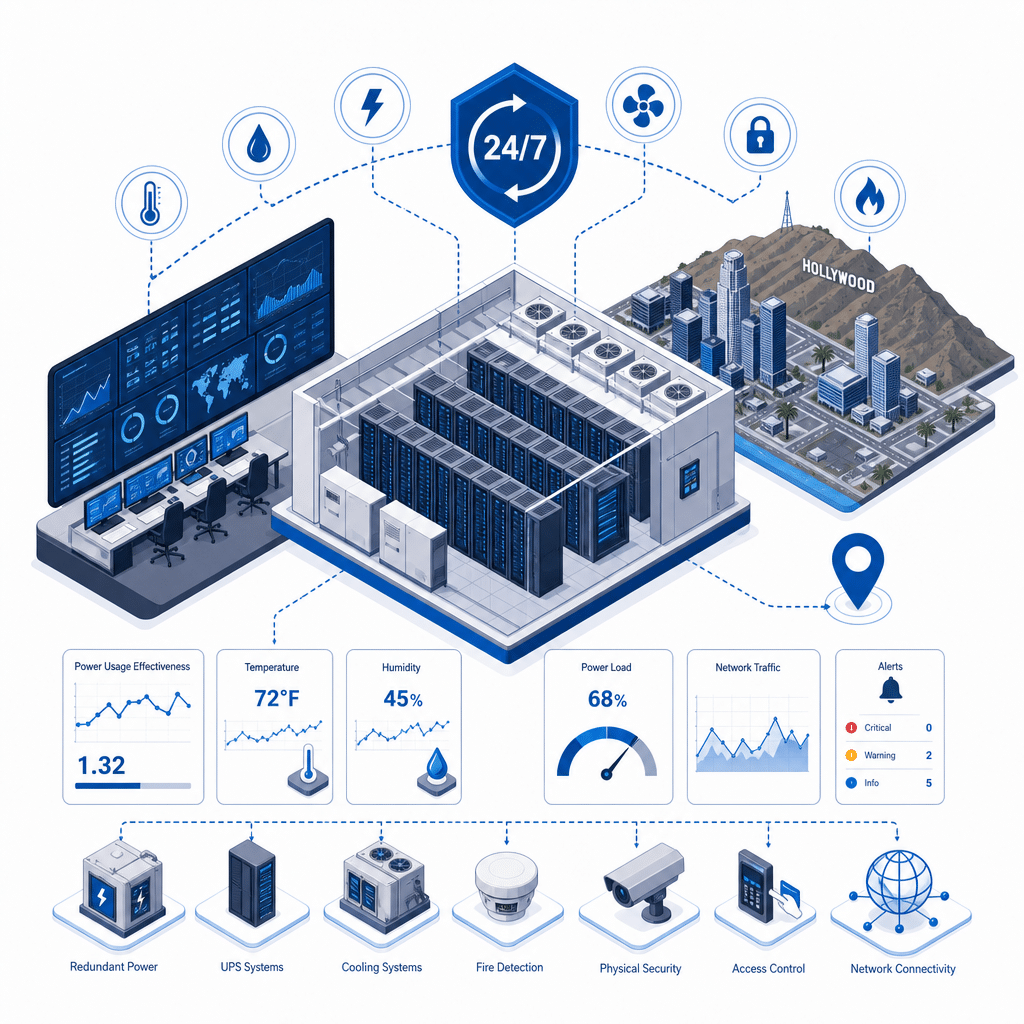
24/7 Data Center Monitoring: Key Statistics for LA Businesses
Sources: IBM Cost of a Data Breach Report 2024, ITIC 2024 Hourly Cost of Downtime Survey, Uptime Institute Annual Outage Analysis 2024.
Breach Detection Times and Why 258 Days Is a Business-Ending Number
IBM’s 2024 Cost of a Data Breach Report found that the average time to identify and contain a breach was 258 days, which was actually a seven-year low and still represents more than eight months of undetected attacker access. Breaches with lifecycles longer than 200 days averaged $5.46 million in total cost, compared to significantly less for breaches caught early
.
The global average cost of a data breach reached $4.88 million in 2024, a 10% increase over the $4.45 million average in 202 3. U.S.-based companies specifically averaged $9.36 million per breach, meaning an LA company without continuous monitoring is playing against the most expensive breach environment in the w
orld.
A 24/7 NOC and SOC model changes the math by compressing detection time from months to minutes. When a monitoring platform flags anomalous outbound traffic at 3 a.m., a trained analyst can isolate the affected segment, engage the incident response playbook, and contain the event before it propagates across the environment.
For LA businesses in regulated verticals, healthcare organizations under HIPAA, financial services firms under GLBA, or retailers subject to PCI DSS, the regulatory fine exposure layered on top of breach costs makes fast detection not just a financial preference but a compliance requirement.
What 24/7 Data Center Monitoring Actually Covers
Comprehensive 24/7 data center monitoring in LA spans four distinct layers: physical security (CCTV, biometric access control, motion detection), environmental controls (temperature, humidity, power draw, cooling unit status), network infrastructure (bandwidth utilization, latency, BGP route changes, firewall rule violations), and application health (service availability, response times, error rates). Each layer produces a stream of telemetry that feeds into a centralized dashboard watched by live analysts.
Physical monitoring matters more than most IT managers acknowledge. A server room that crosses 85 degrees Fahrenheit without triggering an alert can destroy a rack of drives within minutes.
Biometric access logs that go unreviewed create a window for insider threats or unauthorized contractor activity that no firewall rule will catch.
Network-layer monitoring catches the intrusion attempts, DDoS traffic spikes, and misconfigured routing changes that cause most security incidents and many outages. Real-time thresholds allow the NOC team to reroute traffic, null-route an attacking IP block, or spin up a failover instance before users ever notice a slowdown.
Application-layer monitoring closes the last gap by watching whether the actual service, the checkout flow, the patient portal login, the media transcoding pipeline, is behaving as expected. Infrastructure can appear healthy while an application layer sits silently broken, and only end-to-end synthetic monitoring catches that class of failure reliably.
LA-Specific Risks That Make Around-the-Clock Monitoring Non-Negotiable
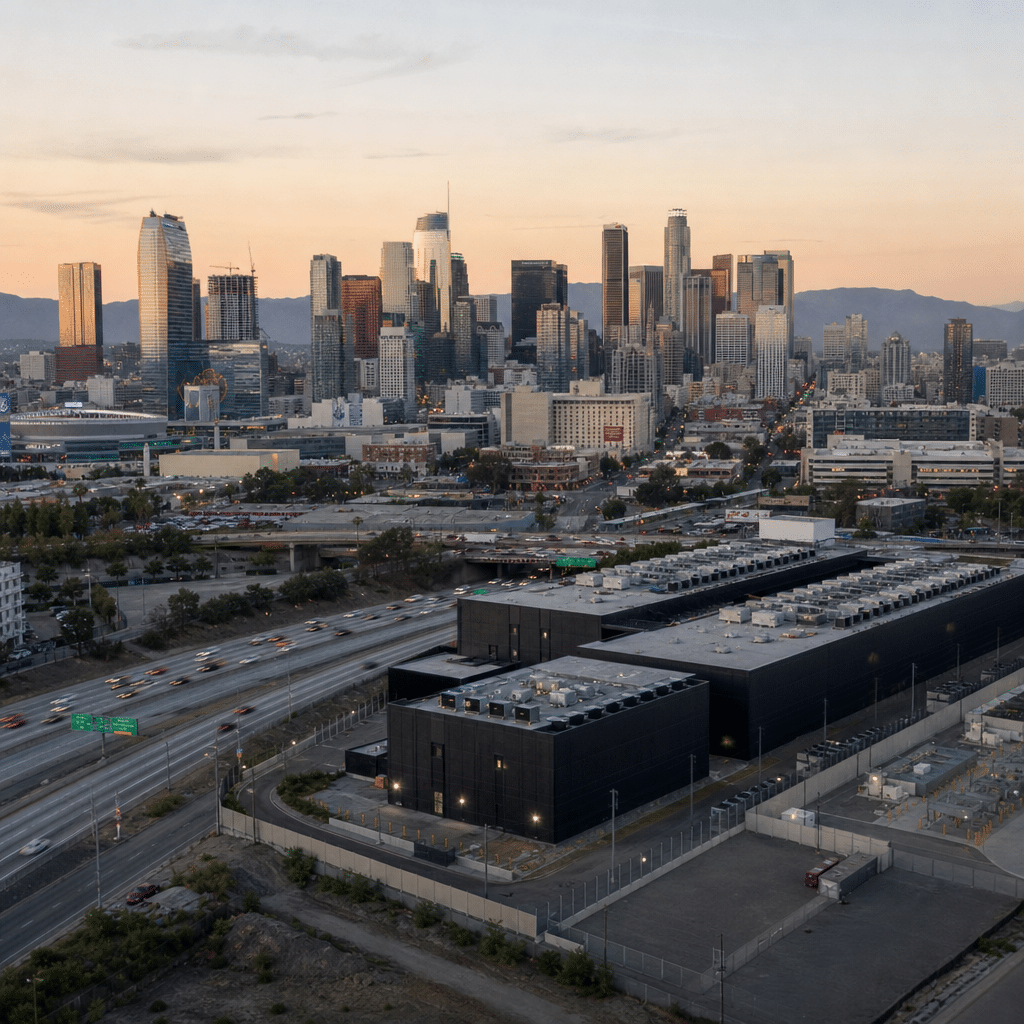
Los Angeles faces a combination of physical and cyber risk factors that few other US metros share at the same intensity. Seismic activity, wildfire-driven power grid instability, and the city’s role as a major Pacific Rim internet exchange point all create threat vectors that demand continuous attention rather than business-hours oversight.
California’s Consumer Privacy Act (CCPA) and its amendment under CPRA impose notification requirements and potential statutory damages that can multiply the cost of a breach affecting California residents. An LA business that detects and contains a breach within hours has far more control over its notification timeline and legal exposure than one that discovers the incident months later.
The entertainment and media sector concentrated in Los Angeles handles extremely high-value intellectual property, and unreleased content leaks carry reputational and contractual consequences that dwarf the direct IT cost. Continuous monitoring of access logs and data exfiltration patterns is the standard of care for any production company or studio using shared colocation infrastructure.
Healthcare organizations in LA, which include some of the largest hospital networks in the state, are frequent ransomware targets precisely because downtime directly affects patient safety. The California Department of Health Care Services has increased enforcement scrutiny after several high-profile incidents, making 24/7 monitoring both a best practice and a defensible due-diligence record.
Choosing the Right 24/7 Monitoring Partner in Los Angeles
Not all monitoring services are equivalent, and the difference between a basic alerting tool and a fully staffed NOC-SOC is the difference between getting an email at 3 a.m. and having a trained analyst already working the problem when you wake up.
LA businesses should ask prospective partners for documented mean time to respond (MTTR) metrics and escalation runbooks before signing any agreement.
Staffing depth matters as much as technology. A monitoring platform run by a two-person team that goes dark on holidays is not true 24/7 coverage.
Look for providers with redundant analyst shifts, a defined escalation chain, and a tested incident response process that includes client communication at each stage.
Integration with your existing colocation provider, MSP, or cloud platform is a practical requirement, not a nice-to-have. A monitoring partner that cannot ingest telemetry from your specific hardware generation or cloud API will have blind spots that defeat the purpose of the engagement.
Ask for a technical scope document that lists every integration by name.
TVG serves LA businesses across industries with fully staffed 24/7 monitoring that covers physical security, environmental systems, network infrastructure, and application health. Our team responds to alerts in minutes, not hours, and we document every incident with a root-cause report so you can demonstrate due diligence to auditors, insurers, and clients.
Year-Over-Year Trends That Justify the Investment
The cost trajectory is moving in one direction. Global average breach costs rose 10% from $4.45 million in 2023 to $4.88 million in 2024, and the trend line over the prior five years shows consistent annual increase
s. Businesses that treat monitoring as a discretionary cost are effectively absorbing a larger uninsured liability each year they defer the investmen t.
Detection and containment times improved slightly in 2024, dropping from 277 days to 258 days on average, but that improvement came almost entirely from organizations that deployed AI-assisted monitoring and threat intelligence feeds. Manual or reactive monitoring approaches saw no meaningful improvement in detection speed.
Downtime frequency is also increasing for businesses that rely on aging infrastructure without continuous oversight. The Uptime Institute’s data shows that the percentage of outages crossing the $100,000 cost threshold has held at 54% for two consecutive years, suggesting that the industry has not made structural progress on incident cost reduction without monitoring-led interventions.
For LA businesses evaluating the ROI of 24/7 monitoring, the calculation is straightforward: compare the annual cost of a staffed monitoring service against the probability-weighted cost of a single undetected breach or multi-hour outage. At $9.36 million average breach cost for US companies, even a modest reduction in breach likelihood produces a return that dwarfs the monitoring investment
.
Frequently Asked Questions
What does 24/7 data center monitoring in LA typically include?
A full-service monitoring engagement covers physical security (CCTV and biometric access logs), environmental telemetry (temperature, power, cooling), network infrastructure (bandwidth, routing, firewall events), and application availability. The specific integrations depend on your colocation provider, cloud platform, and hardware stack, so always confirm the technical scope in writing before engaging a provider.
How much does unmonitored downtime actually cost a mid-size LA business?
ITIC’s 2024 survey found that more than 90% of mid-size and large enterprises lose more than $300,000 per hour of unplanned downtime. For LA businesses running e-commerce, healthcare, or media workloads, a four-hour off-hours outage without monitored failover can erase a quarter’s worth of margin in a single incident.
Can 24/7 monitoring reduce the time it takes to detect a data breach?
Yes, and the financial difference is significant. Breaches caught and contained in under 200 days cost substantially less than the $5.46 million average for breaches with lifecycles over 200 days
. Continuous NOC and SOC monitoring compresses detection from the industry average of 258 days to a matter of minutes by flagging anomalous behavior in real time .
Are there California-specific regulations that require continuous monitoring?
CCPA and CPRA impose data breach notification obligations and potential statutory damages for California residents’ data, and HIPAA requires covered entities to implement technical safeguards and audit controls that effectively mandate continuous monitoring for LA healthcare organizations. Financial services firms are subject to GLBA requirements that similarly call for documented intrusion detection and response capabilities.
What should I look for when selecting a 24/7 monitoring provider in Los Angeles?
Prioritize documented MTTR metrics, clearly defined escalation runbooks, redundant analyst staffing across all shifts including holidays, and confirmed technical integrations with your specific infrastructure stack. A provider that cannot show you a live dashboard of your environment and a past incident report within the first conversation is not ready to protect your business.
How does TVG’s monitoring service differ from a basic alerting tool?
Basic alerting tools send notifications when thresholds are crossed but leave the analysis and response to your internal team, which is a problem at 3 a.m. on a Sunday.
TVG’s fully staffed NOC-SOC has trained analysts watching every alert in real time, working the incident, and communicating status to your team so the problem is being actively resolved before you are even aware of it.

About the author
Garett Chipman - CEO, TVG Consulting
Garett Chipman is an IT executive and entrepreneur with more than 20 years of experience designing business technology solutions. He founded TVG Consulting in 2005 after holding CTO and management roles at companies including GRB Entertainment and AMG, and as CEO he oversees overall client operations, strategic technology decisions, and custom AI and automation design.