

If you run a small business in Los Angeles and have started pricing cybersecurity services, you have probably noticed the quotes vary wildly: a few hundred dollars a month to several thousand, sometimes with no clear explanation for the difference. The numbers are not random, and once you understand what drives them, building a realistic budget becomes much more straightforward.
TVG works with LA-area small businesses every day, and the questions we hear most often come down to the same thing: what does this actually cost, and what do I actually get? This guide breaks down the real pricing landscape for Los Angeles in 2026, from basic endpoint protection to fully managed SOC coverage, so you can compare quotes with confidence.
Key takeaways from this article:
- Los Angeles MSPs typically charge $125-$220 per user per month for bundled managed IT and cybersecurity, rising to $150-$300 for compliance-heavy or advanced security tiers.
- A cybersecurity-only add-on (when IT support is already covered) generally runs $35-$65 per user per month, making it the most cost-efficient entry point for businesses with an existing support contract.
- Break-fix and project-based security work in LA is billed at $100-$300 per hour, with emergency response often starting at $300 per hour, a strong financial argument for proactive managed coverage.
- According to IBM’s 2025 data, US companies face an average breach cost of $10.22 million, while small businesses specifically can expect $120,000 to $1.24 million per incident, numbers that dwarf annual prevention spending.
What Drives Cybersecurity Costs for Los Angeles Small Businesses
Cybersecurity pricing in Los Angeles is shaped by a handful of factors that most providers will not volunteer upfront: user count, device count, compliance requirements, and the depth of monitoring you actually need. A five-person dental practice that must meet HIPAA requirements will pay more than a five-person marketing agency with no regulated data, even if both businesses look identical on paper.
The local labor market also matters, and Los Angeles has one of the highest concentrations of cybersecurity talent in the country, which adds upward pressure on what providers charge per hour and per user. Businesses in entertainment, healthcare, and financial services face additional cost drivers from contract-level security requirements and California privacy regulations.
California’s Consumer Privacy Act (CCPA) and its successor the CPRA add a compliance layer that businesses in other states simply do not face. Providers who understand how to address those frameworks command a premium, and for regulated LA businesses, that premium is worth paying.
Finally, the size of your attack surface (how many endpoints, servers, cloud workloads, and remote users you have) directly determines your per-device and per-user bill. A 10-person shop with 15 laptops, a shared server, and a distributed remote workforce looks very different to an MSP than a 10-person shop sharing two workstations in a single office.
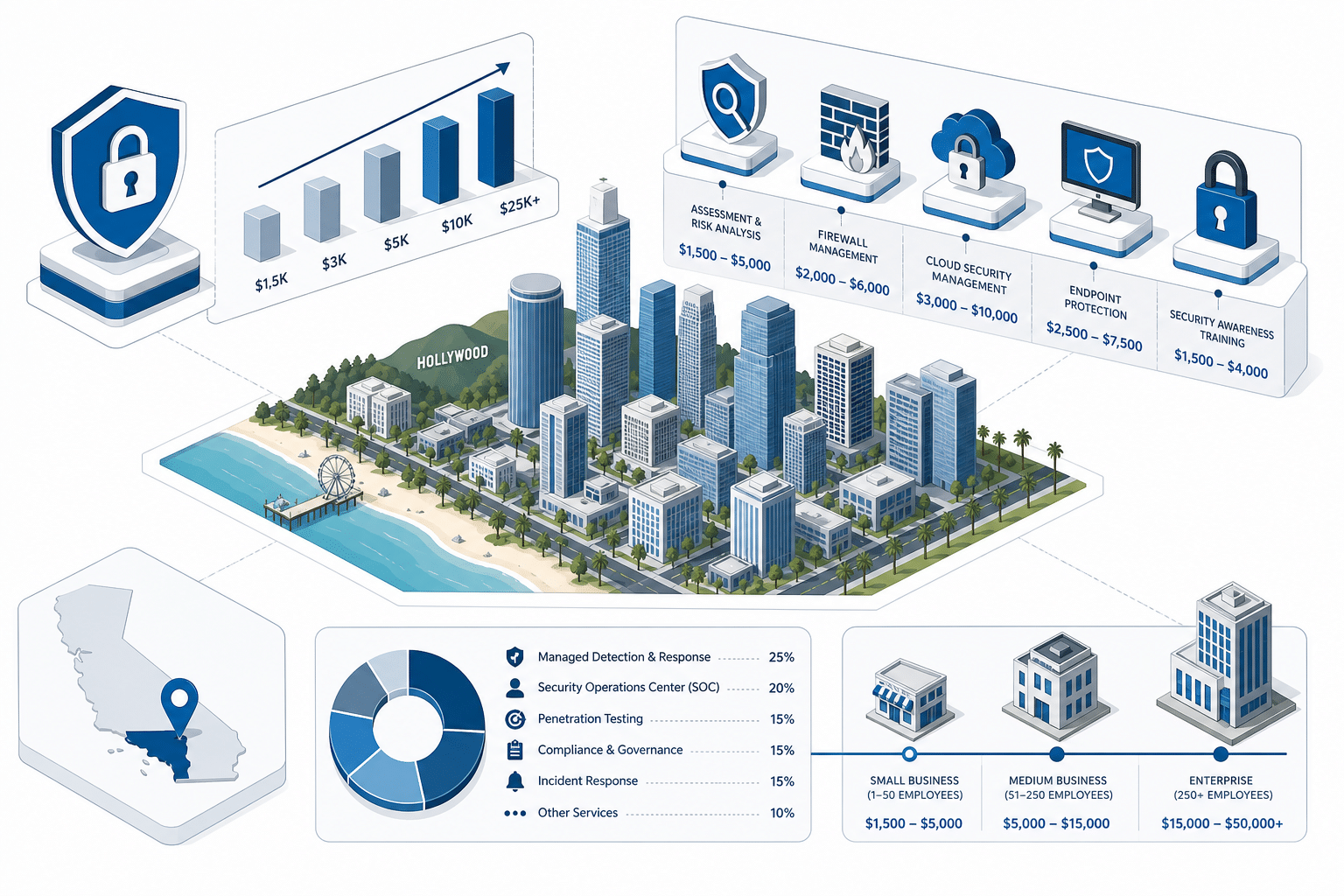
2026 Cybersecurity Pricing Reference for Los Angeles Small Businesses
Sources: LA MSP market rates compiled from provider benchmarks; IBM 2025 Cost of a Data Breach Report; Verizon DBIR 2025; IANS Research 2025 Security Budget Benchmark. Rates reflect 2026 Los Angeles market conditions and vary by industry, user count, and compliance requirements.
Los Angeles MSP Pricing Tiers: From Basic Monitoring to Full SOC
The most common pricing model you will encounter from Los Angeles MSPs is a per-user monthly fee that bundles IT support and cybersecurity together. The standard SMB tier for this bundle runs $125-$220 per user per month and typically covers endpoint protection, patch management, email security, and helpdesk support.
Step up to an advanced or compliance tier and the range shifts to $150-$300 per user per month, adding 24/7 SOC monitoring, SIEM log management, vulnerability scanning, and the compliance documentation that regulated industries require. For a 15-person firm, that translates to a monthly bill ranging from roughly $2,250 at the lower end to $4,500 at the upper end.
If you want to separate cybersecurity from your IT support contract (perhaps because you already have an internal IT person or a helpdesk-only MSP), a cybersecurity-only add-on typically runs $35-$65 per user per month. That range covers managed endpoint detection and response (EDR), email filtering, DNS protection, and basic security awareness training without bundling in IT helpdesk costs.
At the highest tier, managed EDR with 24/7 SOC monitoring is priced per endpoint rather than per user. Expect to pay $15-$75 per endpoint per month, with the lower end reflecting lightweight monitoring and the upper end covering active threat hunting, automated response playbooks, and a dedicated analyst team reviewing alerts around the clock.
Per-Service Cost Breakdown: What You Actually Pay For
Most MSP bundles are built from individual tools and services, each of which carries its own licensing and management cost. Understanding the building blocks helps you evaluate whether a bundle is a good deal or just a markup on tools you could source differently.
Endpoint protection, email security, and DNS filtering (the three controls that block the majority of attacks) each run $7-$20 per user per month in software licensing alone. Add management overhead and you typically see another $12-$40 per user on top, which is why per-user bundles priced at $35-$65 pencil out even after accounting for provider margin.
Managed backup and disaster recovery is often priced by data volume and recovery time objective, with basic setups starting around $50-$150 per month and robust solutions with tested recovery and offsite replication running $300-$800 per month. This is one of the most overlooked line items in cybersecurity budgets, and one of the most impactful when ransomware strikes.
Security awareness training with simulated phishing typically runs $3-$8 per user per month, a low cost relative to the protection it delivers. Compliance-specific add-ons (HIPAA risk assessments, PCI DSS quarterly scans, CCPA readiness documentation) are usually billed as one-time or annual project fees ranging from $1,500 to $10,000 depending on scope.
Incident response retainers are the service category most LA small businesses skip until it is too late, yet a retainer agreement that guarantees priority forensics access typically costs $5,000-$25,000 per year. Without one, emergency hourly IR rates start at $300 per hour and can reach $500 per hour, running around the clock until the incident is contained.

Break-Fix vs. Managed Security: The True Cost Comparison for LA Businesses
Some LA businesses still rely on break-fix security work, where standard hourly rates run $100-$200 for routine tasks and emergency or specialized response starts at $300 per hour. A single breach investigation requiring 20 hours of emergency labor already costs more than a full year of proactive managed security for most small businesses.
The math shifts further when you factor in downtime, as IBM’s 2025 Cost of a Data Breach Report puts the average US breach cost at $10.22 million and the average time to identify and contain an incident at 241 days . Most small businesses cannot sustain a nine-month security incident while staying operational
.
For LA small businesses specifically, the relevant comparison is the $120,000-$1.24 million range that Verizon and IBM report as typical SMB breach costs . Compare that to an annual managed security spend of roughly $15,000-$36,000 for a 10-person company (at $125-$300 per user per month), and the risk-adjusted case for managed coverage becomes straightforward
.
The break-fix model also leaves gaps in continuous monitoring, meaning a threat that enters your environment on a Tuesday night will not be seen until your next on-demand service call, which could be days away. Managed SOC coverage means an alert fires within minutes, dramatically shrinking the window attackers have to move laterally through your environment.
Budget Benchmarks: How Much Should an LA Small Business Actually Spend
Industry benchmarks from IANS Research show companies spent an average of 0.69% of revenue on cybersecurity in 2024-2025 . For an LA small business generating $2 million in annual revenue, that translates to roughly $13,800 per year (about $1,150 per month) as a starting floor
.
The 2024 Security Budget Benchmark Report places cybersecurity at 13.2% of total IT budgets on average . For an SMB paying $3,000 per month to an MSP, roughly $396 of that monthly spend should be allocated explicitly to security controls, though many well-designed LA MSP bundles already fold that coverage into the base price
.
A practical starting framework for a 5-25 person LA business is to target $1,500-$5,000 per month for fully bundled managed IT and security. The lower end handles basic monitoring, patching, endpoint protection, and helpdesk for micro-businesses; the upper end covers compliance requirements, 24/7 SOC, advanced threat hunting, and multi-site environments.
Businesses in regulated industries (healthcare, legal, finance, and entertainment companies handling talent or IP data) should budget toward the higher end and add compliance-specific project fees. California’s strict privacy laws mean the cost of a documented compliance failure often exceeds the cost of the controls that would have prevented it.
Why the Cost of Skipping Cybersecurity Is Higher in Los Angeles
Los Angeles is home to a disproportionate concentration of high-value industries (entertainment, healthcare, professional services, and financial firms) that make its small businesses attractive targets for financially motivated attackers. The city’s dense mix of regulated data, IP, and payment information creates a threat profile that puts LA small businesses in a higher-risk category than those in most other US markets.
According to the 2025 Verizon Data Breach Investigations Report, ransomware appeared in 88% of breaches involving small and medium businesses, and the average ransomware attack cost $5.08 million in 2025 per IBM’s data . Approximately 60% of small businesses that suffer a significant cyberattack close within six months, and those figures do not shrink because a business is local or assumes it is not a high-profile target
.
California’s CCPA and CPRA expose non-compliant LA businesses to statutory fines of $100-$750 per consumer per incident for breaches involving personal information. A breach affecting just 500 customer records could generate $50,000-$375,000 in statutory damages alone, before any forensics, remediation, or legal fees are added.
The strongest argument for investing in cybersecurity is simply the math: prevention costs 50-60 times less than recovery, placing annual prevention spending of $5,000-$15,000 against potential single-incident costs above $500,000 (AlphaCIS). For a Los Angeles small business, those numbers represent the difference between a routine operating expense and a business-ending event.
Frequently Asked Questions
What does a typical small business in Los Angeles pay for cybersecurity each month?
A 10-person LA business on a fully bundled managed IT and cybersecurity plan typically pays $1,250-$2,200 per month at the standard tier ($125-$220 per user). If cybersecurity is purchased as a standalone add-on on top of an existing IT contract, the cost drops to roughly $350-$650 per month for the same team ($35-$65 per user).
Is it cheaper to add cybersecurity to my existing MSP contract or buy a separate security package?
Adding a cybersecurity layer to an existing IT support contract is almost always more cost-efficient than switching providers or running parallel contracts. The $35-$65 per user per month add-on range reflects the fact that the provider already manages your endpoints and does not need to rebuild onboarding costs from scratch.
What is the difference between managed EDR and full SOC monitoring?
Managed EDR (Endpoint Detection and Response) monitors and responds to threats at the device level (laptops, desktops, and servers), typically for $15-$25 per endpoint per month at the entry level. Full SOC monitoring adds log aggregation, network traffic analysis, cloud workload visibility, and 24/7 human analyst review, pushing costs toward $50-$75 per endpoint per month and higher depending on scope.
Does better cybersecurity lower my cyber insurance premium in Los Angeles?
Yes, and in many cases insurers now require documented controls (MFA, EDR, encrypted backups, and a tested incident response plan) before they will quote a policy at all. Businesses that can demonstrate those controls tend to qualify for lower premiums and higher coverage limits, making the monthly security spend partially offset by insurance savings.
When does it make sense for a small LA business to pay for an incident response retainer?
An IR retainer makes sense as soon as your business holds customer data, payment information, or any regulated records, which describes the majority of LA small businesses. At $5,000-$25,000 per year, a retainer is far less expensive than the $300-$500 per hour emergency rate you pay without one, and it guarantees priority response time when you need it most.
How does California’s CCPA affect cybersecurity costs for LA small businesses?
The CCPA and the newer CPRA require businesses that collect personal data from California consumers to implement reasonable security measures and disclose breach incidents. Non-compliance exposes LA businesses to statutory fines of $100-$750 per affected consumer per incident, meaning even a modest breach can generate five- or six-figure fines on top of remediation costs.