

Choosing a managed data center in Los Angeles is one of those infrastructure decisions that quietly shapes your uptime, your security posture, and your monthly burn rate for years. Get it right and your team stops thinking about power, cooling, and connectivity altogether.
This guide breaks down how managed data centers in Los Angeles actually compare on the specs that matter, what colocation, managed, and cloud each cost in this market, and how to shortlist providers without wasting weeks on sales calls. The goal is a clean reference you can hand to a CFO or a CTO and have everyone on the same page.
Key takeaways from this article:
- A true managed data center in Los Angeles should deliver at least 99.99 percent uptime SLA, N+1 power and cooling, and dual-carrier connectivity by default.
- Colocation gives you the lowest long-term cost but the most operational burden. Managed services trade a higher monthly bill for hands-off operations, patching, and 24×7 remote hands.
- LA power costs run roughly 18 to 22 cents per kWh for commercial rates, which is why efficient PUE (1.4 or better) materially affects your monthly bill.
- Security tier (SOC 2 Type II, ISO 27001, PCI DSS, HIPAA) should match your compliance scope, not the provider’s marketing page.
Why Los Angeles Is a Strategic Data Center Market
Los Angeles sits at the intersection of trans-Pacific subsea cables, dense fiber from One Wilshire, and a deep customer base across media, entertainment, healthcare, aerospace, and finance. That mix makes the LA metro one of the lowest-latency hops between Asia-Pacific traffic and the rest of North America.
For a business headquartered in Southern California, keeping workloads in a managed Los Angeles facility usually means sub-5 ms round-trip latency to local users and direct cross-connects to almost every major carrier and cloud on-ramp. That is hard to replicate by going out of region.
The tradeoff is cost. Power, real estate, and labor in LA are more expensive than in inland markets like Phoenix or Las Vegas, so you pay a premium for proximity, ecosystem density, and disaster recovery separation from Northern California.
For more on our broader Data Centers approach, review the parent service page.
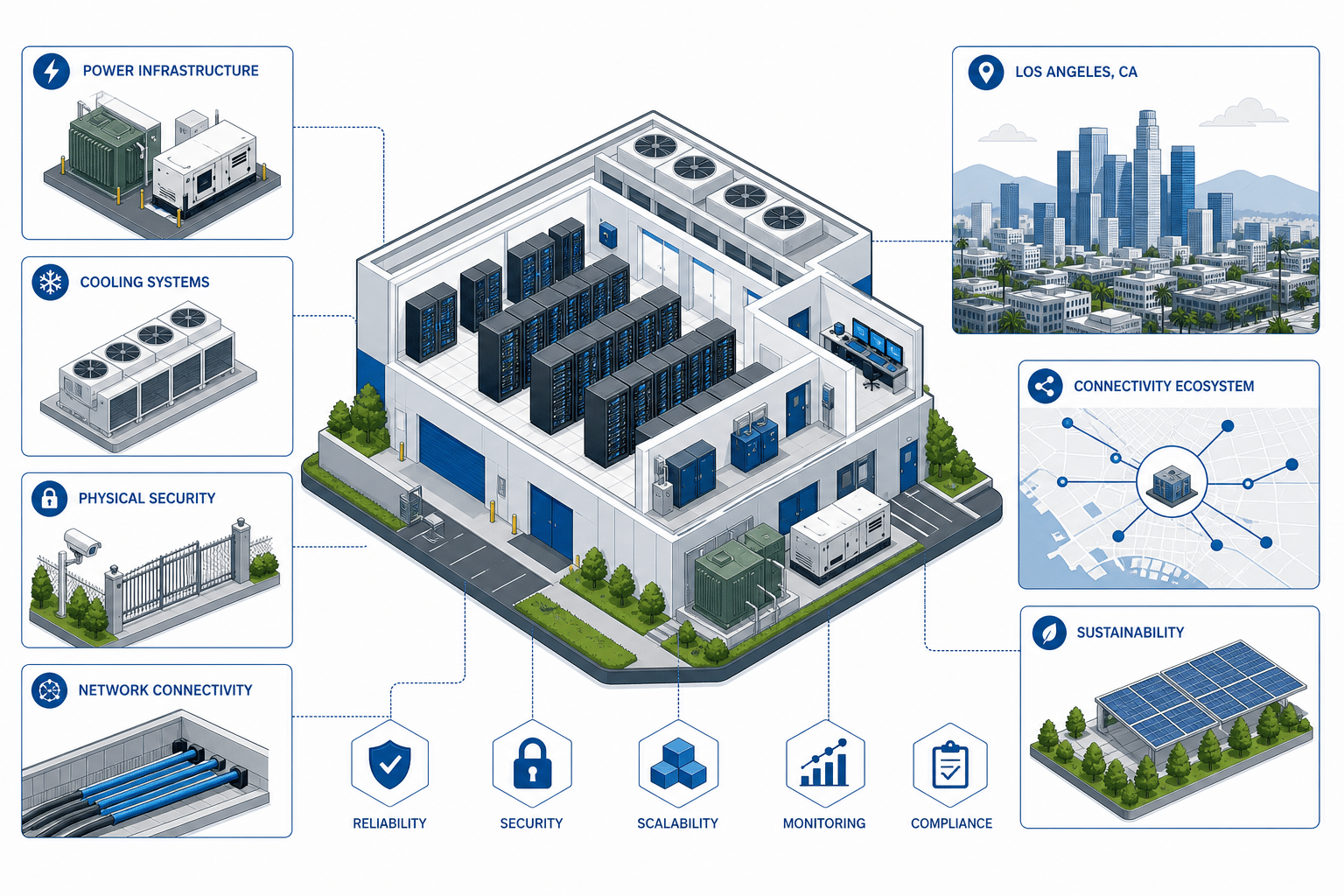
Los Angeles Managed Data Center Comparison: Colocation vs. Managed vs. Cloud
Benchmarks reflect typical 2024 to 2025 LA metro pricing for mid-market deployments. Confirm specifics with each provider under NDA.
Colocation vs. Managed Data Center vs. Cloud: What You Are Actually Buying
Colocation is a real estate and power product. You bring your own servers, switches, and operating systems, the provider gives you space, power, cooling, and physical security.
A managed data center adds an operations layer on top of colocation. The provider handles hardware procurement, OS patching, monitoring, backups, and remote hands, often under a defined SLA tied to response time and incident resolution.
Public cloud, by contrast, abstracts the hardware entirely and bills by consumption. It is the fastest to spin up but the hardest to forecast, and for steady-state workloads it is frequently 2x to 3x more expensive than a well-sized managed footprint in an LA facility.
Most mid-market Los Angeles businesses end up with a hybrid: managed dedicated infrastructure for predictable production workloads, plus cloud for burst capacity, dev/test, and edge services.
The Specs That Actually Matter When You Compare Providers
Uptime SLA is the headline number, but read the fine print. A 99.999 percent SLA that only covers power and cooling is not the same as a 99.99 percent SLA that covers network, power, cooling, and managed services end to end.
Power redundancy should be at least N+1, with 2N preferred for production workloads. Look for dual utility feeds where available, on-site diesel generators with at least 48 hours of fuel, and UPS systems that are tested under load on a documented schedule.
Cooling matters more in LA than people realize. Summer ambient temperatures and Santa Ana wind events stress chillers, so a facility running hot-aisle containment with N+1 CRAC units and a PUE of 1.4 or better will both perform better and bill less.
Connectivity is the last big differentiator. A serious LA managed data center should offer at least 10 carriers on net, direct cross-connects to AWS, Azure, and Google Cloud, and a path to One Wilshire or Equinix LA1 for peering.
Los Angeles Data Center Comparison Table
The table below summarizes the specs and tradeoffs across colocation, managed data center, and public cloud as deployed in the LA market. Use it as a shortlist filter, not a final answer.
Numbers reflect typical mid-market deployments of 10 to 50 kW of critical load. Enterprise deployments at 200 kW or more will negotiate different terms, especially on power pricing and SLA credits.
What Managed Services Should Include in 2025
At minimum, a managed data center contract in Los Angeles should include 24×7 monitoring, OS and firmware patching, backup management, and unlimited remote hands within a defined response window. Anything less is really colocation with a support add-on.
Stronger contracts add managed firewall, DDoS mitigation, vulnerability scanning, and a documented disaster recovery runbook tested at least annually. For regulated workloads, the provider should also produce SOC 2 Type II and any vertical-specific attestations on request.
Pay attention to the response time tiers. A 15-minute response for Severity 1 incidents with a named engineer is meaningfully different from a 4-hour ticket queue, and the price gap is usually smaller than you think.
Real LA Cost and Availability Benchmarks
Wholesale colocation in the LA metro is currently pricing in the range of 150 to 220 dollars per kW per month for 250 kW or larger commitments. Retail colocation for a single cabinet at 5 kW typically runs 800 to 1,400 dollars per month before cross-connects.
Managed services on top of that footprint usually add 30 to 60 percent to the monthly bill, depending on how much of the OS, database, and security stack the provider takes over. Cross-connects in LA average 250 to 400 dollars per month each, which adds up fast in a multi-cloud architecture.
Availability is tightening. Vacancy in the LA primary market dropped below 5 percent in 2024, so lead times for large power blocks are now 6 to 12 months, and rate cards have moved up about 8 to 12 percent year over year.
How to Shortlist a Managed Data Center Partner in Los Angeles
Start with the non-negotiables: required compliance scope, minimum uptime SLA, target latency to your user base, and the specific cloud on-ramps you need. Any provider that cannot check those boxes drops off the list immediately.
Next, do a physical tour. A 30-minute walkthrough of the data hall, the generator yard, and the security control room tells you more than any sales deck, and a provider that resists site visits is telling you something important.
Finally, validate the SLA with real numbers. Ask for the last 12 months of incident reports, mean time to repair, and SLA credits issued, and have your team review the master service agreement for carve-outs around scheduled maintenance and force majeure.
Frequently Asked Questions
What is the difference between colocation and a managed data center in Los Angeles?
Colocation gives you space, power, cooling, and physical security, but you operate your own servers, network, and software. A managed data center adds operations on top, including monitoring, patching, backups, and remote hands, usually tied to a defined service level agreement.
In LA pricing, expect managed services to add 30 to 60 percent to a comparable colocation bill.
What uptime SLA should I expect from a Los Angeles managed data center?
A serious LA facility should offer at least 99.99 percent uptime, which translates to under 53 minutes of allowable downtime per year . Tier III equivalent designs with concurrent maintainability are the practical floor for production workloads
. Read the SLA carefully to confirm whether it covers only power and cooling or also network and managed services .
How much does a managed data center cost in Los Angeles?
Retail colocation for a single 5 kW cabinet typically runs 800 to 1,400 dollars per month, with managed services adding 30 to 60 percent on top. Wholesale deployments of 250 kW or more price in the range of 150 to 220 dollars per kW per month.
Cross-connects, bandwidth commits, and compliance add-ons are billed separately and can add 1,000 to 5,000 dollars per month for a typical mid-market footprint.
Which compliance certifications should a LA data center provider hold?
At a baseline, look for SOC 2 Type II and ISO 27001. Healthcare workloads should require HIPAA attestations and a signed BAA, payment workloads need PCI DSS, and federal contractors should look for FedRAMP or CMMC alignment.
Always ask for the latest report under NDA rather than relying on a logo on the website.
How long does it take to migrate to a managed data center in Los Angeles?
A small migration of 1 to 5 cabinets typically takes 6 to 10 weeks from contract signature to production cutover. Larger migrations involving database replication, custom networking, or compliance reviews usually run 3 to 6 months.
Power availability is currently the longest lead time in the LA market, so reserving capacity early is the single best way to compress the schedule.

About the author
Garett Chipman - CEO, TVG Consulting
Garett Chipman is an IT executive and entrepreneur with more than 20 years of experience designing business technology solutions. He founded TVG Consulting in 2005 after holding CTO and management roles at companies including GRB Entertainment and AMG, and as CEO he oversees overall client operations, strategic technology decisions, and custom AI and automation design.