

If your Nashville business has more than 20 employees, someone on your team is dealing with a tech problem right now, and the speed at which that problem gets solved determines whether the workday moves forward or stalls. A frozen laptop in a Green Hills healthcare office, a dropped VPN in a Brentwood financial firm, or a printer outage in a Germantown studio all carry a real cost.
TVG Consulting works with small and mid-size Nashville businesses to provide helpdesk services that meet measurable benchmarks rather than vague promises. This guide covers exactly what to evaluate, what Nashville-specific numbers to demand from any provider, and how to score your options using a straightforward comparison framework.
Businesses evaluating their current support arrangements can find a detailed breakdown of what to prioritize in Helpdesk Services in Nashville.
Key takeaways from this article:
- Top Nashville helpdesk providers publish a 10-minute average response time for non-emergency tickets and resolve urgent issues in under 20 minutes, so use those figures as your minimum contract requirement.
- First-call resolution rate and CSAT score are the two most predictive metrics for long-term helpdesk quality, and best-in-class Nashville providers have documented a 91.73% FCR and 98.57% CSAT across 7,500-plus end users.
- Hiring a full-time IT person in Nashville costs $55,000 to $85,000 per year before benefits and tools, while outsourced managed helpdesk support runs $75 to $175 per user per month for fully managed coverage.
- A flat-fee or per-user pricing model is far easier to budget than per-incident billing, and it aligns your provider’s incentive with fast resolution rather than extended billable time.
Why Nashville Businesses Need a Reliable Helpdesk Partner
Nashville’s economy spans healthcare, logistics, financial services, entertainment, and professional services, and all of them depend on technology that works consistently during business hours and beyond. When a system fails at a Medical Mile clinic, a distribution facility in Antioch, or a law office downtown, the downtime cost is immediate and measurable.
Forrester 2024 research found that only 55% of workers feel their service desk actually supports them, which means nearly half of all employees are frustrated by the very system designed to keep them productive. That frustration compounds over time into missed deadlines, IT-related churn, and reduced confidence in the tools your business has invested in.
HDI data shows that 67% of clients switch IT providers when initial response time exceeds 30 minutes, which means a slow helpdesk does not just hurt productivity, it puts your vendor relationship at risk. Selecting a Nashville helpdesk service with published, verifiable SLA benchmarks is the most direct way to make sure your team never waits that long.
The scorecard at the bottom of this article translates those benchmarks into a side-by-side comparison of in-house, outsourced, and hybrid support models, giving Nashville buyers a structured way to evaluate proposals rather than relying on sales conversations alone.
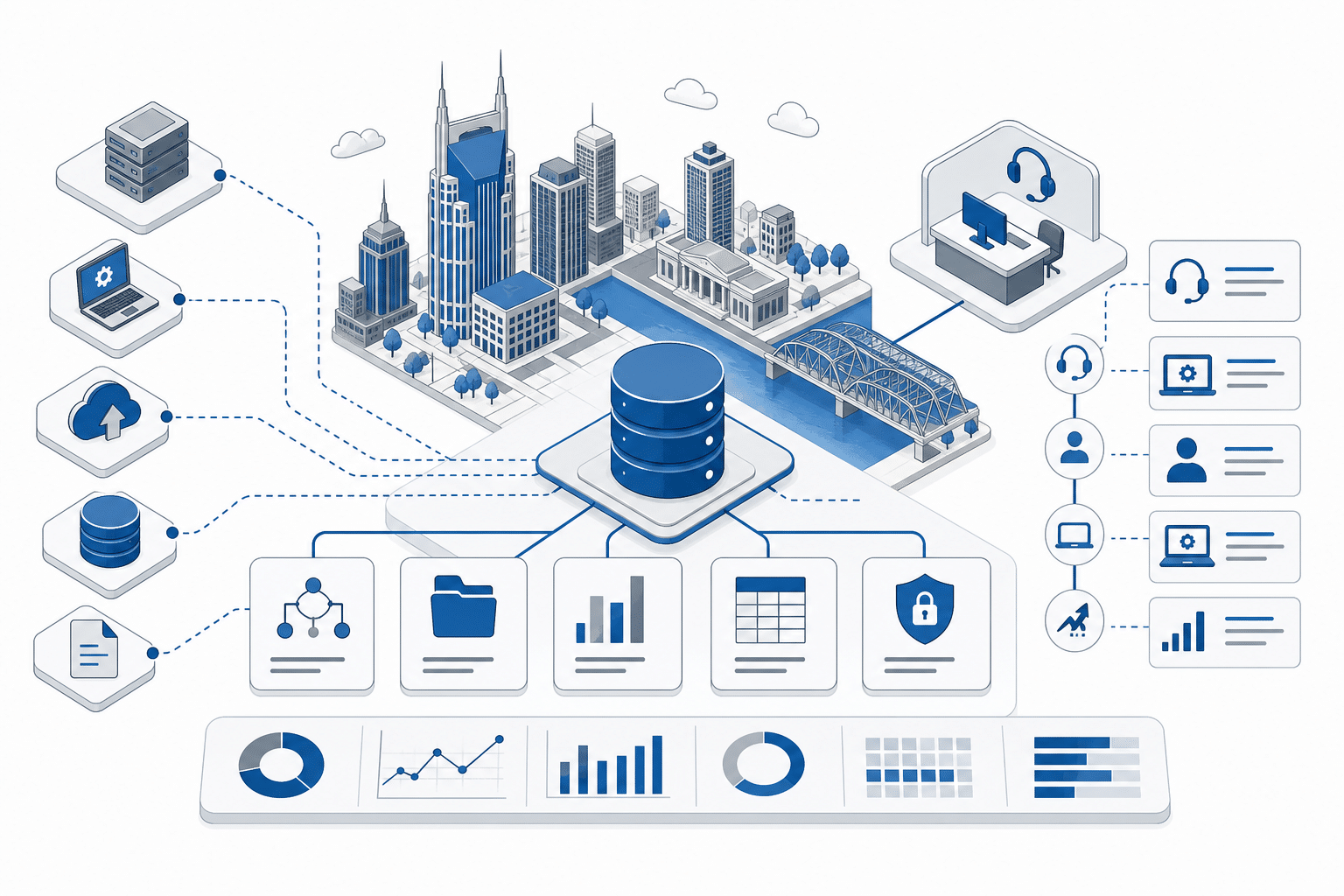
Five Criteria Every Nashville Business Should Score
Response time is the first number to lock down in any SLA. Top Nashville helpdesk providers target a 10-minute average response on non-emergency tickets, while the benchmark for urgent issue resolution is under 20 minutes, and both figures should appear as hard commitments in any contract you sign.
First-call resolution rate (FCR) measures how often a ticket is fully closed on the first contact, with no callback, no follow-up email, and no second session required. A local benchmark of approximately 91.73% is published by leading Nashville providers, and that figure is the floor to hold vendors to when scoring proposals
.
CSAT score gives you the end-user view of service quality, not just the operational view. Best-in-class Nashville helpdesk operators have reported a 98.57% satisfaction rating across more than 7,500 end users, which demonstrates that high volume and high quality can coexist when processes are mature and technicians are well-trained
.
Availability and coverage model are critical for Nashville businesses that operate outside standard 9-to-5 hours, whether that is an urgent care clinic fielding system failures at 11 p.m. or a restaurant group needing point-of-sale support on a Friday night.
Outsourced Nashville helpdesks commonly include 24/7/365 coverage, while in-house teams are typically limited to business hours unless the company separately funds shifts or on-call arrangements.
Scalability and pricing transparency complete the scorecard. A helpdesk partner should be able to add users, locations, and device types with a simple contract amendment, and their pricing model should be flat-fee or per-user with no surprise overage charges rather than per-incident or per-minute billing that creates misaligned incentives.
In-House vs. Outsourced vs. Hybrid: The Nashville Model Comparison
Hiring a dedicated IT person in Nashville costs $55,000 to $85,000 per year in base salary, before benefits, certifications, RMM software licenses, and management overhead. For most companies with fewer than 75 employees, that level of spending rarely aligns with the actual volume and complexity of tickets generated.
An outsourced Nashville helpdesk amortizes the cost of experienced technicians and enterprise-grade tooling across multiple clients, which sharply reduces per-ticket cost and gives you a deep bench of specialists, including network engineers, cybersecurity analysts, and cloud architects, rather than a single generalist. Outsourcing typically costs 30 to 50 percent less per ticket than a comparable in-house setup.
A co-managed or hybrid model layers outsourced helpdesk capacity on top of an existing internal IT resource, and it is one of the fastest-growing support structures for Nashville businesses with 50 to 200 employees. The internal person handles strategic projects, vendor negotiations, and infrastructure planning while the outsourced team absorbs the daily Tier 1 and Tier 2 ticket volume that would otherwise consume their entire day.
Local Nashville providers offer onsite dispatch capability and familiarity with regional infrastructure, including common internet service providers, healthcare software stacks, and financial compliance requirements. National providers may offer lower per-ticket costs but frequently cannot send a technician to a Gulch office or a Germantown warehouse within a two-hour window when remote resolution is not enough.

Nashville Helpdesk Pricing: What to Budget and What to Avoid
Most Nashville MSPs price fully managed helpdesk support between $75 and $175 per user per month, covering remote support, monitoring, and helpdesk access across standard and extended hours. Entry-level remote-only helpdesk plans start around $45 per desktop per month, though those plans typically require a separate RMM fee that adds meaningfully to the total cost.
Break-fix or per-incident billing from Nashville providers commonly runs $125 to $250 per hour, which looks affordable until a ransomware event, a server failure, or a multi-user outage generates a single invoice that eclipses several months of flat-rate cost. Per-incident pricing also gives your provider zero incentive to resolve tickets quickly, since more time on a ticket equals more billable revenue for them.
Managed IT services that include security, compliance monitoring, and strategic consulting in Nashville broadly run $150 to $250 per user per month. Knowing where helpdesk-only pricing ends and fully managed pricing begins helps you scope correctly and avoid paying for services you have already covered elsewhere.
All-inclusive flat-fee pricing is the structure to prioritize in any Nashville helpdesk RFP. When your provider earns the same amount whether a ticket takes 10 minutes or 2 hours, their incentive structure matches yours: close tickets fast, prevent recurrence, and keep your team productive.
Red Flags and Green Lights When Evaluating Nashville Providers
A green light is a provider that publishes specific SLA metrics, such as average response time, FCR percentage, and CSAT score, and is prepared to include those numbers in a signed contract with a defined remedy if they miss them. A red flag is a provider that describes service quality with words like ‘industry-leading’ or ‘fast response’ without attaching a measurable commitment or a financial consequence for falling short.
Check whether the provider offers both remote support and local onsite dispatch capability in Nashville. A national provider whose nearest certified technician is in Memphis or Atlanta cannot realistically meet a two-hour onsite SLA for a business in Brentwood or Berry Hill.
Ask each vendor how they handle ticket volume spikes, such as a company-wide Microsoft 365 migration, an office move, or a new-hire onboarding wave that doubles your endpoint count for 30 days. A provider with rigid staffing ratios will slow down at exactly the moment your business needs speed.
Confirm that adding new users, devices, or office locations triggers a simple pricing amendment rather than a full contract renegotiation. Nashville businesses growing by acquisition or headcount expansion need a helpdesk partner whose contract structure can keep up with their pace.
How TVG Consulting Delivers Helpdesk Services in Nashville
TVG Consulting provides helpdesk services to Nashville businesses through a combination of remote support, onsite dispatch, and co-managed IT options built around the actual structure of a growing company. Every engagement is backed by a written SLA that specifies response and resolution benchmarks rather than relying on best-effort language.
Our flat-fee pricing model means your monthly IT support cost stays consistent whether your team submits 15 tickets or 150 in a given month, which makes budgeting straightforward for CFOs and operations leaders alike. We also conduct scheduled technology reviews to reduce ticket volume proactively, because a problem that never reaches the helpdesk is the best outcome for your team.
Nashville businesses across healthcare, financial advisory, distribution, and professional services trust TVG to keep their technology running and their teams focused on client work rather than IT problems. If you are comparing helpdesk options right now, the scorecard below provides a structured framework for translating vendor claims into a data-driven decision.
Frequently Asked Questions
What response time should I require from a helpdesk service in Nashville?
For non-emergency tickets, the Nashville benchmark is a 10-minute average response time, and top local providers publish that figure as a committed SLA metric. For urgent issues, target a provider that resolves problems in under 20 minutes on average, and ask them to put both commitments in writing with a defined remedy if they miss.
How does outsourced helpdesk support compare to hiring an in-house IT person in Nashville?
A full-time IT hire in Nashville costs $55,000 to $85,000 per year before benefits, tools, and training, while a fully managed outsourced helpdesk plan typically runs $75 to $175 per user per month. Outsourcing also provides access to a team of specialists across multiple disciplines rather than a single generalist, which matters significantly when issues escalate beyond Tier 1 desktop support.
What is first-call resolution rate and why does it matter for Nashville businesses?
First-call resolution rate (FCR) measures the percentage of support tickets that are fully resolved on the first contact without any follow-up or escalation. A rate above 91% is the credible Nashville benchmark, and a high FCR directly reduces disruption for your employees while lowering your overall cost per ticket.
Should I choose a local Nashville helpdesk provider or a national one?
Local providers offer faster onsite response, familiarity with regional internet infrastructure and common business software stacks, and the face-to-face accountability that national providers cannot replicate. If your team ever needs a technician physically on-site, whether in the Gulch, Germantown, or Antioch, a local Nashville partner with dispatch capability is the more reliable choice.
What is the difference between flat-fee and per-incident helpdesk pricing?
A flat-fee model charges a fixed monthly amount per user or desktop, giving you predictable IT costs regardless of how many tickets your team submits in a given month. Per-incident billing charges each time a ticket is opened, which creates unpredictable costs during busy periods and misaligns your provider’s incentive with your goal of fast, complete resolution.
Next step: See how TVG Consulting handles IT support in Nashville, or call 615-437-3889 to talk with our team.

About the author
Garett Chipman - CEO, TVG Consulting
Garett Chipman is an IT executive and entrepreneur with more than 20 years of experience designing business technology solutions. He founded TVG Consulting in 2005 after holding CTO and management roles at companies including GRB Entertainment and AMG, and as CEO he oversees overall client operations, strategic technology decisions, and custom AI and automation design.