
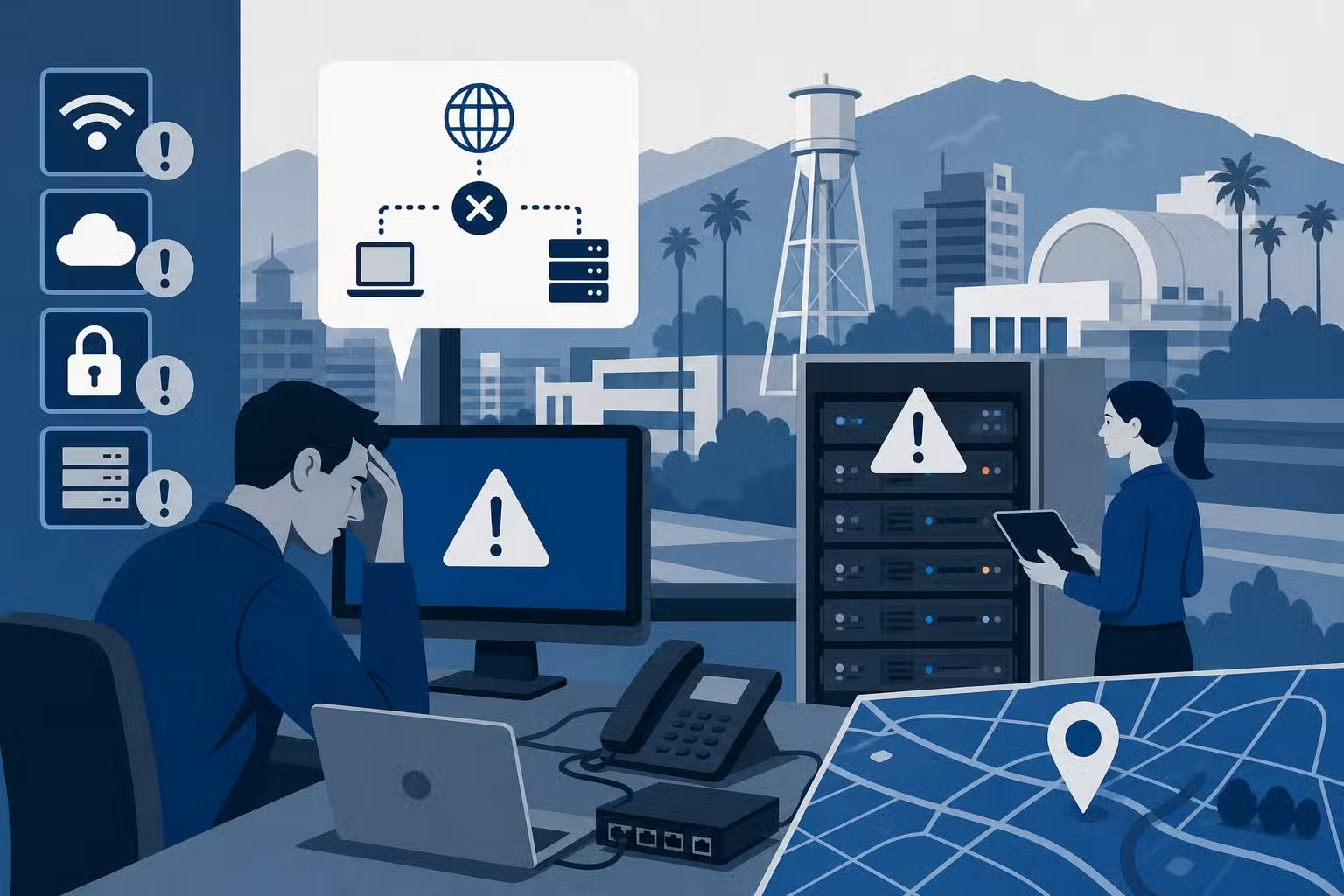
Burbank businesses in media, entertainment, and professional services operate in a fast-moving environment where technology problems translate directly into missed deadlines and lost revenue. When IT issues pile up without a clear resolution path, the damage compounds quickly.
TVG works with Burbank organizations that are tired of putting out fires and ready to build a more reliable foundation. This article breaks down the most common IT support challenges Burbank companies face, scores how those challenges stack up, and offers practical guidance on what a stronger support model actually looks like.
Key takeaways from this article:
- Recurring IT issues that go unresolved week after week are the single biggest drain on productivity for Burbank small and mid-size businesses.
- The problem is rarely the technology itself, it is who is managing it, whether that is an overwhelmed in-house generalist or a reactive MSP that waits for tickets instead of preventing them.
- Cybersecurity risk in the Los Angeles metro is elevated by dense collaboration networks and heavy cloud reliance, making annual security reviews a baseline requirement rather than a luxury.
- A documented IT roadmap aligned to your 12-24 month growth plan is what separates businesses that scale smoothly from those that hit infrastructure walls at the worst possible time.
Why IT Support Challenges in Burbank Look Different Than Elsewhere
Burbank sits at the center of a unique industry mix: post-production studios, talent agencies, streaming service vendors, and corporate professional services firms all share the same city blocks. Each of those sectors puts distinct pressure on IT infrastructure, from high-bandwidth file transfers for media projects to strict compliance requirements for financial and legal practices.
While the challenges covered here affect the broader Burbank business community, IT support challenges Burbank businesses in the McNeil area encounter can be even more pronounced due to the concentration of creative firms and tighter geographic clustering of shared infrastructure.
That industry diversity means a generic IT support playbook rarely fits. A media company moving 4K assets across a shared network has different bottlenecks than an accounting firm managing client portals during tax season, and both are underserved by cookie-cutter support arrangements.
Local Burbank IT providers consistently identify the same cluster of pain points across these industries: recurring ticket backlogs, slow response from overstretched support staff, and a lack of forward-looking planning. Recognizing which challenges your organization carries is the first step toward fixing them.

Recurring IT Issues and Unplanned Downtime
Recurring issues, such as slow systems, network outages, and tickets that get closed without a root-cause fix, are reported by a significant share of Burbank businesses as a weekly disruption. When the same problem resurfaces every few weeks, it is a signal that the underlying cause was never properly diagnosed.
Unplanned downtime compounds the damage. A single four-hour outage during a tight production deadline or a client presentation can erase the productivity gains of an entire week, and the reputational cost with the client can linger long after the systems come back online.
The pattern we see most often is reactive support: a ticket is opened, a symptom is patched, and the ticket is closed. Without proactive monitoring that flags warning signs before a crash, businesses stay locked in a cycle of emergency response that is both expensive and exhausting for internal teams.
Overwhelmed IT Management and the Generalist Problem
Many small Burbank businesses rely on a single in-house IT generalist who is expected to handle everything from printer jams to firewall configuration to onboarding new hires. That person may be skilled, but no single individual can maintain deep expertise across networking, security, cloud platforms, and end-user support simultaneously.
Organizations that need specialized expertise for specific projects or busy seasons without committing to full-time hires should consider IT Staff Augmentation In Burbank as a flexible way to supplement their existing team.
The result is a predictable bottleneck: the generalist becomes the constraint, response times stretch, and strategic work like infrastructure upgrades or security assessments never gets scheduled because the day is already full of break-fix requests. Businesses in this situation often describe their IT as perpetually “behind.”
Some organizations graduate from the generalist model to an MSP, only to discover the MSP is equally reactive. Slow ticket response, account managers who rotate frequently, and no proactive outreach are common complaints.
The label changes but the problem structure stays the same.

Cybersecurity Gaps and Compliance Pressure in the LA Metro
Los Angeles-area businesses face a heightened cybersecurity threat environment because of the density of interconnected networks across entertainment, media, and professional services. A compromise at one vendor or partner can propagate quickly through shared cloud environments and collaborative project platforms.
A formal cybersecurity review, covering threat monitoring, access controls, and employee phishing awareness training, should happen at least once every 12 months. Many Burbank organizations skip this entirely or treat it as optional, which leaves known vulnerability gaps open for extended periods.
Employee training deserves special emphasis because the majority of successful cyberattacks begin with a social engineering attempt directed at a staff member, not a technical exploit. A workforce that can recognize a phishing email or a suspicious login prompt is one of the most cost-effective security controls available.
Strategic IT Planning and Scalability for Growing Burbank Businesses
Technology that cannot scale with the business becomes a ceiling rather than a foundation. A Burbank production company that doubles its project volume in 18 months needs to know in advance whether its network, cloud licensing, and storage infrastructure can absorb that growth without a disruptive overhaul.
A documented IT roadmap answers that question before it becomes a crisis. The roadmap maps current infrastructure against projected headcount, project load, and revenue targets, then identifies the investments needed to stay ahead of demand rather than chasing it.
Strategic planning is also where IT alignment with business goals actually happens. Technology purchases made reactively, without reference to where the business is heading, frequently result in redundant tools, licensing waste, and systems that do not talk to each other, all of which slow down the teams who depend on them.
The Value of 24/7 Monitoring and Industry-Specific Support
Round-the-clock monitoring means problems are identified and escalated before users notice them. A disk array that is filling up at 2 a.m.
on a Wednesday is caught by automated alerting and addressed before the morning shift arrives, rather than causing a slow-down that takes hours to diagnose.
Business-hours-only support is a structural mismatch for Burbank businesses in media and entertainment, where project work routinely runs evenings and weekends. A support model that only operates 9-to-5 leaves critical systems unattended during the hours they are most actively used.
Industry-specific knowledge matters as much as availability. An IT provider that understands the workflow of a post-production house, including render farm management, shared storage protocols, and the specific software stack used in color grading, can resolve issues faster and prevent more of them than a generalist provider learning on the job.
Frequently Asked Questions
What are the most common IT support challenges Burbank businesses report?
The most frequently cited issues are recurring system slowdowns, unplanned outages, and unresponsive IT support, whether in-house or through an MSP. Cybersecurity gaps and a lack of strategic IT planning are close behind, particularly for businesses in media, entertainment, and professional services.
How do I know if my current IT setup is putting my business at risk?
If your team is experiencing the same issues repeatedly without a root-cause fix, or if your IT provider is reactive rather than proactive, those are strong warning signs. A formal IT assessment that reviews your infrastructure, security posture, and support model will surface the specific gaps.
Why is cybersecurity especially important for Burbank companies?
Burbank businesses collaborate heavily across studios, vendors, and agencies, which creates a densely connected network environment where a breach at one organization can spread quickly. The LA metro is a high-value target for ransomware and social engineering attacks, making annual security reviews and employee training non-optional.
What does a proactive managed IT service look like compared to reactive support?
Proactive support includes 24/7 monitoring, scheduled maintenance windows, regular security scans, and strategic planning sessions aligned to your business goals. Reactive support waits for a ticket to arrive before taking any action, which means problems are always addressed after they have already disrupted operations.
How often should a Burbank business update its IT roadmap?
A formal IT roadmap review should happen at least once a year, with a lighter check-in every quarter to account for changes in headcount, project volume, or business direction. Roadmaps that are not revisited become outdated quickly, especially in fast-moving industries like media and entertainment.
Businesses ready to move beyond these recurring challenges can explore how dedicated Burbank IT Support from a local provider with deep industry experience changes the support dynamic entirely.

About the author
Garett Chipman - CEO, TVG Consulting
Garett Chipman is an IT executive and entrepreneur with more than 20 years of experience designing business technology solutions. He founded TVG Consulting in 2005 after holding CTO and management roles at companies including GRB Entertainment and AMG, and as CEO he oversees overall client operations, strategic technology decisions, and custom AI and automation design.