

If your business is colocating servers or networking gear in a Los Angeles facility, the quality of your provider’s support services can mean the difference between a five-minute reboot and a six-hour outage that costs far more than your monthly rack fee.
TVG works with LA businesses every day that are navigating colocation decisions, and this guide walks through exactly what a qualified data center support services provider in LA should deliver, the frameworks that define the standards, and the red flags that signal a facility will let you down when it matters most.
Key takeaways from this article:
- A qualified LA provider must maintain 24/7/365 on-site technicians and remote hands so customers never need to drive to the facility for a reboot or cable swap.
- Uptime Institute Tier III design and a financially backed 100% uptime SLA are the minimum bar for any production workload in Los Angeles.
- SOC 2 Type II attestation, along with PCI-DSS or HIPAA where applicable, is how you verify that security and availability controls are real, not just marketing copy.
- Carrier-neutral interconnection with direct access to One Wilshire and 600 W 7th St gives LA businesses the lowest-latency paths to Asia-Pacific and domestic cloud on-ramps.
Why Data Center Support Services in LA Are a Different Conversation
Los Angeles sits at a unique crossroads: it is one of the primary subsea cable landing points for U.S. to Asia-Pacific traffic, and its carrier ecosystem is anchored by interconnection hubs at One Wilshire and 600 W 7th Stree t. That density creates tremendous opportunity, but it also means the expectations for support quality, uptime, and compliance are higher here than in many secondary market
s.
LA also hosts a diverse mix of industries, from entertainment and media to healthcare and financial services, each carrying its own compliance footprint. A data center support services provider in LA needs to speak fluently to HIPAA, PCI-DSS, and SOC 2 requirements, not just to kilowatt capacity and cross-connect pricing.
The good news is that the frameworks for evaluating these providers are mature and public: Uptime Institute Tier classifications, ANSI/TIA-942, and SOC 2 Type II all give you objective benchmarks to hold a vendor accountable to real standards.
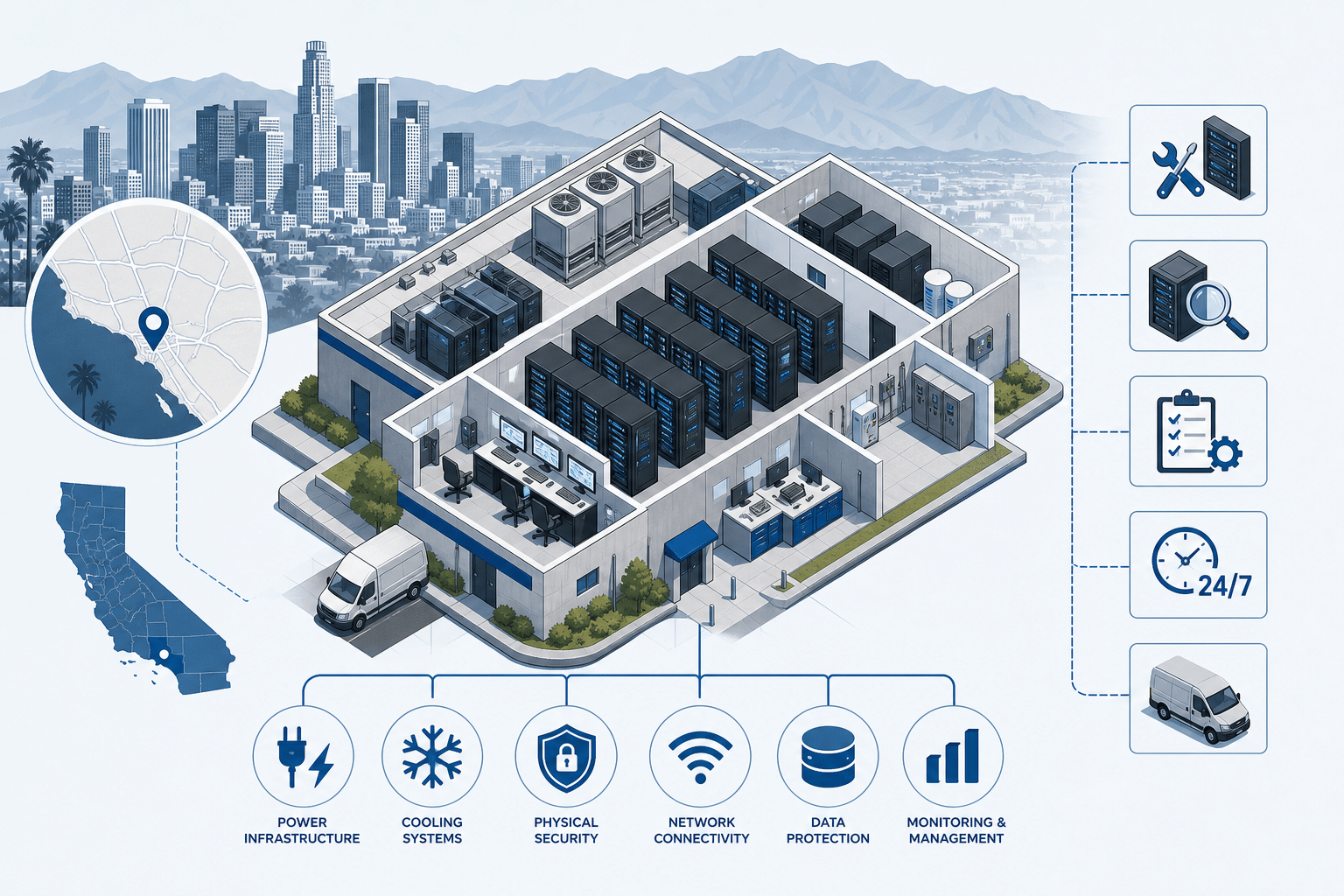
Data Center Support Services in LA: Provider Evaluation Checklist
- ✓24/7/365 on-site technicians and remote hands service: Required, confirm staffing model and after-hours ticket response time target (aim for 15 minutes or less for critical issues)
- ✓Uptime Institute Tier III (or higher) design with N+1 redundancy and concurrent maintainability: Required, request certification documentation or self-assessment; Tier III targets 99.982% availability
- ✓Carrier-neutral facility with meet-me-room and access to One Wilshire or 600 W 7th St: Required, confirm no carrier exclusivity clauses and list of available Tier 1 carriers and cloud on-ramps
- ✓SOC 2 Type II report covering security, availability, and confidentiality trust service criteria: Required, request current report; verify coverage period is at minimum the last 6 months
- ✓Additional compliance attestations matching your workload (PCI-DSS, HIPAA/HITRUST, NIST 800-171): Required where applicable, non-compliance penalties average $1.24M per HIPAA breach; PCI fines can reach $100K/month
- ✓Documented 100% or 99.999% uptime SLA with financial credits on power, cooling, and network stated separately: Required, read exclusions; credits should apply from first minute of outage with no sub-threshold carve-outs
- ✓Multi-layer physical security: mantrap, biometric or NFC authentication, 24/7 guards, continuous video archive (90+ days): Required, verify during facility walkthrough, not only in the sales proposal
- ✓Redundant UPS, diesel/gas generators with verified on-site fuel reserves, precision cooling, VESDA detection, and pre-action dry-pipe fire suppression: Required, request most recent generator fuel log and UPS maintenance report during due diligence
- ✓Scalable space options from 1U/quarter rack through full cabinets and private cages or suites: Required, confirm no migration penalty if footprint grows beyond initial commitment within the same facility
- ✓Pricing benchmark check: quarter rack $150-$400/mo, full cabinet $500-$1,200/mo, remote hands $75-$150/hr: Benchmark reference, use to pressure-test quotes and identify outliers before negotiating
Sources: Uptime Institute Tier Standards, ANSI/TIA-942, AICPA SOC 2 Trust Service Criteria, IBM Cost of a Data Breach Report, PCI Security Standards Council guidelines.
The Core Support Services Your Provider Must Offer
Around-the-clock on-site staffing is the foundation of every other service promise. Without a trained technician physically present at the facility at 2 a.m.
on a Sunday, remote hands tickets, emergency reboots, and hardware swap requests all become hollow commitments.
Even the most robust LA data center infrastructure can only deliver on its promises when problems are caught and resolved in real time, which is why continuous oversight has become a critical layer of the support stack.
Remote hands services let your team perform cabling changes, media swaps, power cycling, and basic hardware replacements through a dispatched technician without anyone from your organization ever entering the data hall. For distributed teams or businesses without dedicated data center staff, this is not a convenience feature, it is an operational necessity.
Scalable space options matter more than most buyers realize at contract signing. A provider that offers flexible footprints from a single 1U slot through quarter racks, full racks, private cages, and dedicated suites lets you grow within the same facility rather than migrating to a new provider when your footprint doubles.
Redundant power, cooling, and fire suppression round out the core infrastructure layer. The minimum credible standard is N+1 redundancy on UPS systems, diesel or natural gas generators with verified on-site fuel reserves, precision cooling, VESDA early-warning smoke detection, and pre-action dry-pipe fire suppression in data hall areas.
Uptime, Compliance, and the Frameworks That Define the Standard
Uptime Institute Tier III is the widely accepted minimum for production enterprise workloads. Tier III requires N+1 redundancy and concurrent maintainability, meaning the facility can perform maintenance on any single component without taking the system offline, and its published availability target is 99.982%, roughly 1.6 hours of allowable downtime per yea
r.
ANSI/TIA-942 is the complementary telecommunications infrastructure standard that covers physical layer design: cabling topology, power path separation, and mechanical system layout. A provider that references both Uptime Institute and TIA-942 alignment signals that its engineering team is working from a documented, auditable design rather than a custom interpretation of best practices.
SOC 2 Type II is the most important compliance attestation to request from any LA colocation provider. Unlike a Type I report that reflects a single point-in-time review, a Type II report covers a minimum six-month operating period and confirms that the provider’s security, availability, and confidentiality controls functioned effectively throughout that window.
Where your workload carries regulated data, look for additional attestations: PCI-DSS for payment card environments, HIPAA/HITRUST for healthcare, and NIST 800-171 for organizations handling Controlled Unclassified Information under federal contracts. A provider that cannot produce these attestations on request is not ready to host those workloads.
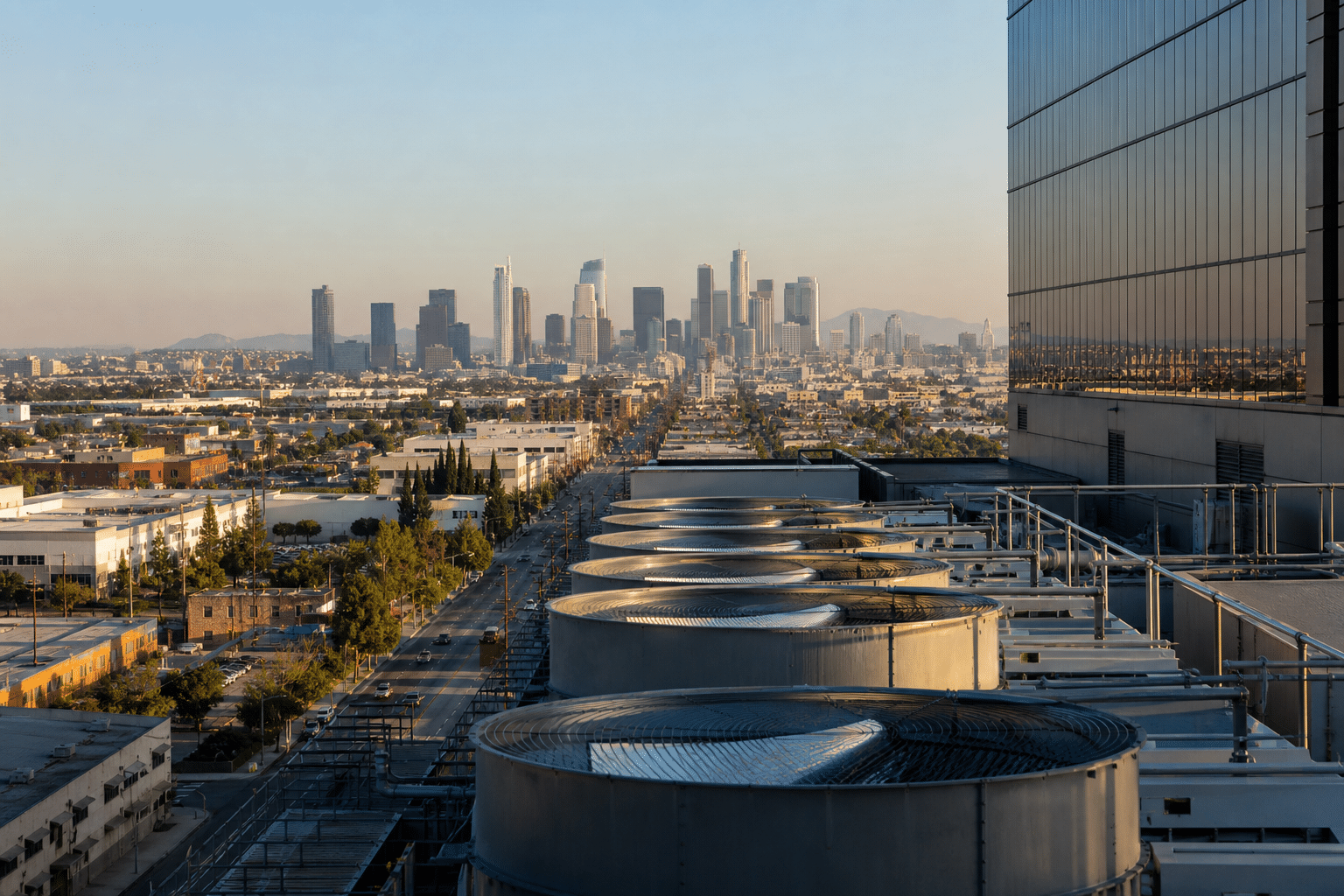
Physical Security and Interconnection: What Good Looks Like
Multi-layer physical security is not optional in a shared colocation environment. The minimum credible configuration includes a mantrap entry vestibule, biometric or NFC badge authentication at the data hall perimeter, 24/7 security guards, and continuous video monitoring archived for at least 90 days.
Some facilities also enforce escort policies for unescorted visitors and require two-person integrity checks for specific zones. These are not bureaucratic inconveniences, they are the controls that show up in your SOC 2 audit as evidence that physical access to your hardware is governed and logged.
Carrier-neutral interconnection is what separates a well-positioned LA facility from a building that just happens to have cooling. A carrier-neutral facility operates a meet-me-room where multiple Tier 1 carriers, ISPs, CDN providers, and cloud on-ramp services terminate, and it does not impose restrictions on which carriers or cloud providers you connect to.
Direct logical access to One Wilshire and 600 W 7th Street, the two dominant LA interconnection hubs, gives your traffic the shortest possible path to trans-Pacific subsea cables and to the major cloud providers’ West Coast points of presence. If a provider cannot clearly explain its path to those hubs, that is a significant gap for any latency-sensitive application.
SLAs, Pricing Benchmarks, and the Cost of Getting This Wrong
A documented, financially backed uptime SLA is the mechanism that converts marketing language into enforceable commitments. The SLA should specify 100% or 99.999% availability on power and network, define the credit structure for any downtime that exceeds the threshold, and apply separately to power, cooling, and connectivity rather than bundling them into a single ambiguous metric
.
Beware of SLAs that offer credits only after a cumulative monthly outage threshold is crossed, or that exclude scheduled maintenance windows so broadly that most real incidents fall outside coverage. Read the exclusions section at least as carefully as the uptime number.
On pricing, LA colocation costs typically run between $150 and $400 per month for a quarter rack and $500 to $1,200 or more for a full cabinet, depending on power density, cross-connect requirements, and the provider’s tier. Remote hands labor generally ranges from $75 to $150 per hour, though many providers include a set number of monthly remote hands hours in managed colocation contracts.
The cost of non-compliance is a more important number than the monthly rack fee for most regulated businesses. A single reportable HIPAA breach carries an average penalty of $1.24 million according to IBM’s Cost of a Data Breach report, and PCI-DSS non-compliance fines from card brands can reach $100,000 per month before any breach event occurs
. Hosting regulated data in a facility that cannot produce a current SOC 2 Type II report is a liability exposure, not just an audit finding .
How to Evaluate and Select a Provider in the LA Market
Start with a site tour, not a sales deck. Walk the facility, confirm that the security layers you were promised in the proposal are physically present, and ask to see the generator fuel log and the most recent UPS maintenance report.
A provider that is confident in its infrastructure will not hesitate to show you the documentation.
Request current copies of the SOC 2 Type II report, any Uptime Institute certification or self-certification documentation, and the full SLA including the exclusions section. If the sales team needs more than 48 hours to produce these, treat that delay as a signal about how the operations team runs day to day.
Ask specifically about remote hands response time targets and how after-hours tickets are triaged. A facility that routes all support requests through a general inbox with a four-hour response window is a different product from one that maintains a dedicated on-site team with a 15-minute response commitment for critical tickets.
Finally, ask for two or three customer references in industries similar to yours. An LA media company and an LA healthcare network have very different support requirements, and a provider that serves both well demonstrates operational range that a provider narrowly focused on one vertical may not.
Frequently Asked Questions
What does remote hands service actually include at an LA data center?
Remote hands typically covers physical tasks your team would otherwise need to perform in person: server reboots, cable connections, media insertions, LED indicator checks, and basic hardware swap-outs on pre-staged equipment. The scope varies by provider, so confirm whether the service includes cross-connect installations, KVM console access assistance, and smart hands tasks like OS-level troubleshooting before you sign a contract.
How do Uptime Institute Tier III and Tier IV differ for LA businesses?
Tier III requires N+1 redundancy and concurrent maintainability, meaning maintenance can happen without a service interruption, and targets 99.982% availability, roughly 1.6 hours of potential downtime annuall y. Tier IV adds fault tolerance so that any single infrastructure failure, not just a maintenance event, cannot interrupt service, and it targets 99.995% availability, or about 26 minutes of allowable downtime per ye
ar.
Is SOC 2 Type II the same as ISO 27001 certification?
They are related but distinct: SOC 2 Type II is an attestation report produced by an independent CPA firm that confirms specific controls operated effectively over a defined period, while ISO 27001 is a certification against an information security management standard issued by an accredited certification body. Many enterprise procurement teams and regulated industries in the U.S. require SOC 2 Type II specifically, so confirm which attestation your compliance or legal team needs before evaluating provider
s.
What should a financially backed SLA actually say in the contract?
Look for explicit uptime percentages for power, cooling, and network stated separately, a credit calculation that applies from the first minute of outage rather than after a multi-hour threshold, and a definition of what constitutes an outage that does not exclude common failure scenarios. Service credits should be meaningful relative to your monthly fee, and the contract should not cap total credits at a level so low that the provider has no financial incentive to maintain the SLA.
What are the typical colocation pricing benchmarks in Los Angeles?
Quarter-rack colocation in LA generally runs from $150 to $400 per month, while full cabinet pricing typically falls in the $500 to $1,200 range depending on power density, cross-connect requirements, and facility tier. Remote hands labor most commonly runs $75 to $150 per hour, though managed colocation bundles at higher-tier providers often include a monthly allotment of remote hands hours.
Can a small business or startup use colocation in LA, or is it only for large enterprises?
Colocation is accessible at almost any scale because reputable LA providers offer flexible entry points starting at a single 1U slot or a quarter rack, which lets a five-person startup place a single server in a Tier III facility for less than the cost of building equivalent power and cooling in an office. The real value is that the startup gets enterprise-grade redundancy, carrier-neutral connectivity, and SOC 2-backed security from day one, without the capital expense of building private infrastructure.

About the author
Garett Chipman - CEO, TVG Consulting
Garett Chipman is an IT executive and entrepreneur with more than 20 years of experience designing business technology solutions. He founded TVG Consulting in 2005 after holding CTO and management roles at companies including GRB Entertainment and AMG, and as CEO he oversees overall client operations, strategic technology decisions, and custom AI and automation design.